
daffodil-logo
daffodil-logo-black
daffodil-logo
  • Services
    • Consulting
    • Design
    • Software Development
    • AI/ML Solutions
    • Software Testing and QA
    • Software Maintenance and Support
    • Marketing
    • Team Augmentation
    Software-Consulting-1

    Software Consulting

    End-to-end software consulting services for web, mobile, and cloud-based solutions

    Layer_x0020_1-1

    Cloud Consulting

    Architect and optimize cloud-native solutions that enhance agility, resilience, and cost efficiency.

    Legacy-System-Modernization

    Legacy System Modernization

    Modernize legacy systems into secure, scalable, and future-ready digital platforms.

    Security-Compliance-Advisory

    Security & Compliance Advisory

    Strengthen your technology landscape by embedding security and compliance into every layer.

    AI-Strategy-Consulting

    AI Strategy Consulting

    Unlock business value by defining and implementing a clear, results-driven AI roadmap.

    UX-Design

    UI/UX Design

    Design intuitive, user-centric interfaces that elevate engagement and drive measurable outcomes.

    Vector-1

    Discovery & MVP Planning

    Validate product ideas and define a focused MVP roadmap that accelerates time to market.

    Product-Experience-Design

    Product Experience Design

    Craft seamless end-to-end product experiences that align user needs with business goals.

    Custom-Web-App-Development

    Web Application Development

    Build scalable, high-performance web applications tailored to your unique business workflows.

    Mobile-App-Development

    Mobile App Development

    Develop intuitive, feature-rich mobile apps that deliver seamless experiences across devices.

    SaaS-Platform-Development

    SaaS & Platform Development

    Engineer robust, extensible platforms that support growth, integrations, and evolving business needs.

    API-Integrations

    API Development & Integrations

    Connect systems and streamline operations by designing secure, reliable APIs and integrations.

    Cloud-Services

    Cloud Services

    Enable agility and resilience by migrating, managing, and optimizing your cloud infrastructure.

    Group

    Cloud-Native Applications

    Create resilient, scalable cloud-native applications built for performance and rapid innovation.

    DevOps

    DevOps Services

    Accelerate releases and improve reliability by implementing automated, scalable DevOps practices.

    Agentic-AI-1

    Data & ML Engineering

    Design and operationalize scalable data pipelines and ML systems that power intelligent decision-making.

    Data-ML-Engineering

    GenAI & LLM Solutions

    Develop generative AI and LLM-powered applications that automate workflows and enhance human productivity.

    Conversational-AI

    Conversational AI Solutions

    Create intelligent conversational systems that deliver natural, context-aware customer interactions.

    Agentic-AI-1

    Agentic AI Solutions

    Deploy autonomous AI agents that reason, plan, and execute complex tasks across systems.

    Computer-vision-solutions

    Computer Vision solutions

    Implement computer vision systems that extract real-time insights from images and video streams.

    Manual-Automation-Testing

    Automation Testing

    Execute comprehensive manual and automated testing to accelerate releases without compromising reliability.

    Security

    VAPT Testing

    Optimize system performance by identifying bottlenecks and validating stability under peak loads.

    Performance-Load-Testing

    Performance Testing

    Identify vulnerabilities and strengthen defenses through rigorous security testing and risk assessment.

    API-Integrations

    API Testing

    Validate APIs for reliability, performance, and security to ensure seamless communication between systems and applications.

    Application-Maintenance

    Software Maintenance and Support

    Ensure stability and continuous improvement through proactive monitoring, maintenance, and ongoing application support.

    Feature-Enhancements

    Application Modernzation

    Transform legacy applications into scalable, cloud-ready systems built for performance and agility.

    Managed-Cloud-Services

    Cloud Migration

    Migrate applications and infrastructure to the cloud with minimal disruption and optimized performance.

    Performance-Marketing

    Performance Marketing

    Drive measurable growth by running data-driven campaigns optimized for conversions, CAC, and ROI.

    SEO

    SEO Services

    Improve organic visibility and rankings by optimizing your content, technical SEO, and search authority.

    AIO

    App Store Optimization

    Improve app visibility and downloads by optimizing listings, keywords, and conversion elements across app stores.

    Analytics-Graph-Browser-Statistics-Online

    Data Enrichment

    Enhance your datasets with accurate, actionable insights that improve targeting, personalization, and decision-making.

    Group-1

    Hire Dedicated Developers

    Extend your team with skilled dedicated developers who align with your goals, workflows, and delivery timelines.

    Offshore-Development-Center

    Offshore Development Center

    Set up a scalable offshore development center to accelerate product delivery while optimizing costs and operational efficiency.

  • Industries
    • Healthcare
    • Software & Technology
    • Fintech
    • Digital Commerce
    • Travel & Transportation
    • Media and Entertainment
    • Banking Sector
    • Food & Beverages
    EHR-development

    Healthcare Software Development

    Build secure, compliant healthcare solutions that improve patient outcomes and streamline operations.

    Custom-Healthcare-solutions

    Healthcare Apps Development

    Tailored healthcare apps built around your workflows, patients, and care delivery goals.

    Telemedicine-app-development

    Telemedicine App Development

    Secure virtual care platforms that connect patients and providers anytime, anywhere.

    EHR-development

    EMR/EHR Development

    Intelligent EMR/EHR systems that streamline clinical workflows and improve care coordination.

    Patient-Engagement-solutions

    Patient Engagement Solutions

    Digital experiences that keep patients informed, connected, and actively engaged in their care journey.

    RPM

    RPM Solutions

    Remote patient monitoring solutions that enable proactive care beyond hospital walls.

    Home-Care-Software-Development

    Home Care Software Development

    Smart home healthcare platforms that simplify caregiving, scheduling, and patient management.

    AI-based-Healthcare-Solutions

    AI-Based Healthcare Solutions

    AI-powered healthcare solutions that automate operations, enhance diagnostics, and improve patient outcomes.

    SaaS-Product-Development

    SaaS Product Development

    Scalable SaaS products engineered for rapid growth, seamless user experiences, and recurring revenue.

    Software-Modernization

    Software Modernization

    Modernize legacy systems with cloud-native architectures, better performance, and future-ready technology.

    Offshore-Development-Center-1

    Offshore Development Center

    Build a high-performing offshore development team that works as a seamless extension of your business.

    Hire-dedicated-developers

    Hire Software Developers

    Access skilled developers on demand to accelerate product delivery and scale engineering capacity.

    CTO

    CTO as a Service

    Get strategic technology leadership and product direction without the cost of a full-time CTO.

    POS-Solutions

    POS Solutions

    Intelligent POS solutions that streamline billing, inventory, and customer experiences across retail operations.

    Custom-Accounting-Solutions

    Custom Accounting Solutions

    Tailor-made accounting software designed to simplify financial operations and improve business visibility.

    Stock-Trading-Platforms

    Stock Trading Platforms

    High-performance trading platforms built for secure, real-time, and seamless stock market transactions.

    Gold-Trading-Platforms

    Gold Trading Platforms

    Robust digital platforms for secure gold trading, portfolio management, and real-time market insights.

    Insurtech-Solutions

    Insurtech Solutions

    Innovative insurance technology solutions that automate processes and enhance customer experiences.

    eCommerce-app-development

    eCommerce App Development

    Feature-rich eCommerce apps designed to deliver seamless shopping experiences across devices.

    D2C-commerce-solutions

    D2C Commerce Solutions

    Direct-to-consumer commerce platforms that help brands drive engagement, loyalty, and sales growth.

    Marketplace-development

    Marketplace Development

    Scalable multi-vendor marketplace platforms built for smooth transactions and business expansion.

    Retail-software-solutions

    Retail Software Solutions

    End-to-end retail software solutions that optimize operations, inventory, and customer experiences.

    Logistics-Software-development

    Travel Application Development

    Custom travel applications that simplify bookings, itineraries, and customer experiences.

    Fleet-Asset-Management-Systems

    Fleet & Asset Management Systems

    Smart fleet and asset management systems that improve tracking, utilization, and operational efficiency

    Ticketing-Fare-Management

    Ticketing & Fare Management

    Digital ticketing and fare management solutions built for seamless payments and transit operations.

    OTT-Platform-Development

    OTT Platform Development

    Build feature-rich OTT platforms that deliver seamless video streaming experiences across web, mobile, and smart devices.

    Live-Streaming-Applications

    Live Streaming Applications

    Develop scalable live streaming applications with real-time broadcasting, low latency, and interactive user experiences.

    Custom-CRM-Software-1

    CMS Solutions

    Create flexible, user-friendly CMS solutions that simplify content management and support seamless digital experiences.

    CORE-Banking-Software

    CORE Banking Software

    Develop secure, scalable core banking software that streamlines financial operations and enhances customer experiences.

    Cloud-Banking-Software

    Cloud Banking Software

    Build cloud-based banking solutions that improve agility, scalability, and operational efficiency for modern financial institutions.

    Loan-Management-Software

    Loan Management Software

    Create intelligent loan management software to automate lending workflows, improve compliance, and accelerate loan processing.

    Inventory-Management-Systems

    Inventory Management Systems

    Build intelligent inventory management systems that optimize stock control, streamline operations, and reduce inefficiencies.

    POS-Systems

    POS Systems

    Develop reliable POS systems that simplify transactions, improve customer experiences, and support business growth.

    Restaurant-Management-Software

    Restaurant Management Software

    Create comprehensive restaurant management software to streamline orders, inventory, billing, and daily operations.

    Custom-CRM-Software-1

    Custom CRM Software

    Design custom CRM software tailored to your workflows to improve customer engagement, sales tracking, and business efficiency.

  • Client Success
  • Discover Daffodil
    About-Us

    About US

    Discover who we are, what we build, and the values that drive our innovation journey.

    Partnership

    Partnerships

    Collaborate with us to create scalable technology solutions and shared business success.

    Career-Culture

    Career & Culture

    Build your future with a team passionate about technology, innovation, and growth.

    layer1

    Leadership

    Meet the leaders shaping our vision, culture, and technology-driven growth

    Podcasts

    Podcasts

    Explore conversations on technology, innovation, business trends, and digital transformation.

    Insight-Blogs

    Insights Blog

    Insights, trends, and expert perspectives from the world of technology and software engineering.

    CSR

    Corporate Social Responsibility

    Driving meaningful social impact through responsible initiatives and community-focused programs.

    • Software Consulting
    • Cloud Consulting
    • Legacy System Modernization
    • Security & Compliance Advisory
    • AI Strategy Consulting

    • UI/UX Design
    • Discovery & MVP Planning
    • Product Experience Design

    • Web Application Development
    • Mobile App Development
    • SaaS & Platform Development
    • API Development & Integrations
    • Cloud Services
    • Cloud-Native Applications
    • DevOps Services

    • Data & ML Engineering
    • GenAI & LLM Solutions
    • Conversational AI Solutions
    • Agentic AI Solutions
    • Computer Vision solutions

    • Automation Testing
    • VAPT Testing
    • Performance Testing
    • API Testing

    • Software Maintenance and Support
    • Application Modernzation
    • Cloud Migration

    • Performance Marketing
    • SEO Services
    • App Store Optimization
    • Data Enrichment

    • Hire Dedicated Developers
    • Offshore Development Center

    • Healthcare Software Development
    • Healthcare Apps Development
    • Telemedicine App Development
    • EMR/EHR Development
    • Patient Engagement Solutions
    • RPM Solutions
    • Home Care Software Development
    • AI-Based Healthcare Solutions

    • SaaS Product Development
    • Software Modernization
    • Offshore Development Center
    • Hire Software Developers
    • CTO as a Service

    • POS Solutions
    • Custom Accounting Solutions
    • Stock Trading Platforms
    • Gold Trading Platforms
    • Insurtech Solutions

    • eCommerce App Development
    • D2C Commerce Solutions
    • Marketplace Development
    • Retail Software Solutions

    • Travel Application Development
    • Fleet & Asset Management Systems
    • Ticketing & Fare Management

    • OTT Platform Development
    • Live Streaming Applications
    • CMS Solutions

    • CORE Banking Software
    • Cloud Banking Software
    • Loan Management Software

    • Inventory Management Systems
    • POS Systems
    • Restaurant Management Software
    • Custom CRM Software
Client Success

    About US

    Partnerships

    Career & Culture

    Leadership

    Podcasts

    Insights Blog

    Corporate Social Responsibility

Get in Touch
blog header image.png

Curated Engineering Insights

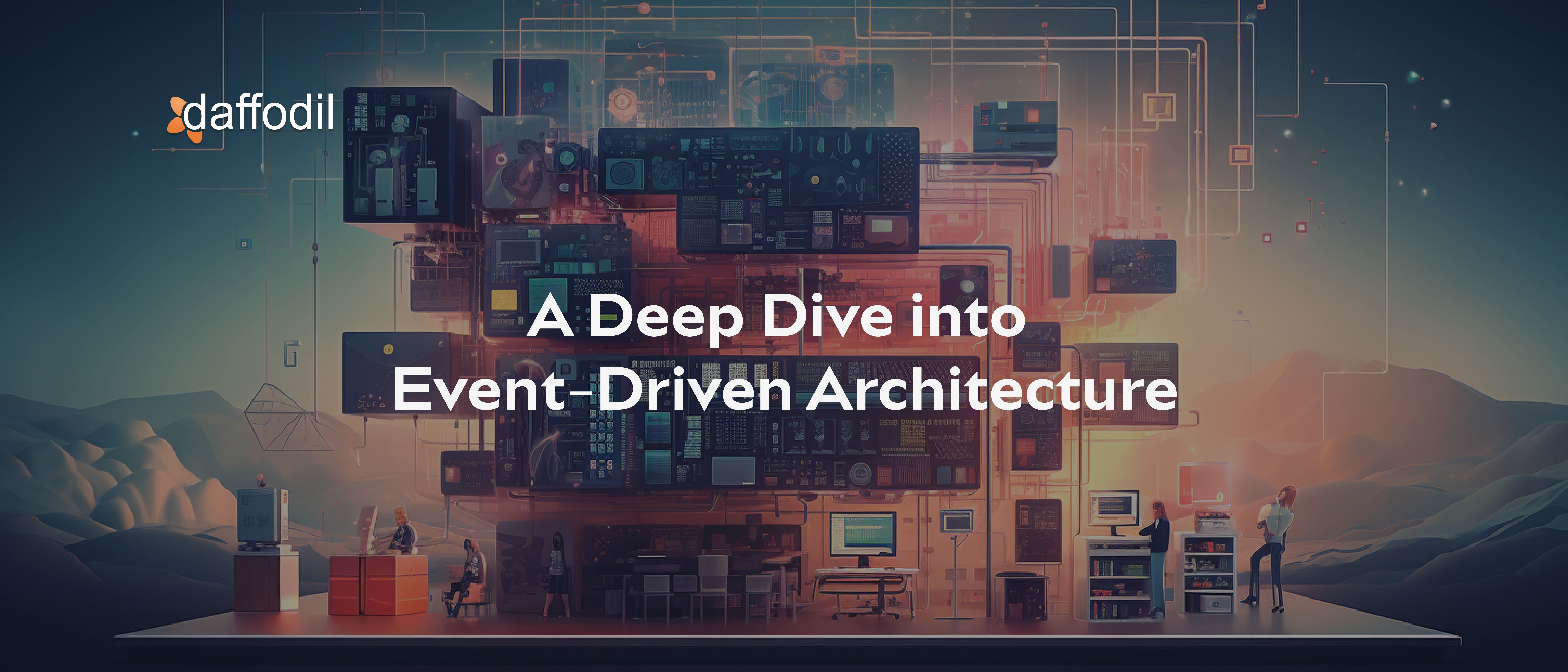
Event-Driven Architecture Explained: Real-World Examples, Models, & Benefits

Oct 16, 2023 4:00:00 PM

  • Tweet

Event-Driven Architecture Explained: Real-World Examples, Models, & Benefits

In today's digital age, where every click, transaction, and interaction matter, how we design software systems has transformed significantly. Think of it this way: picture a smart home system that adjusts the lighting and temperature based on your actions, just like a responsive assistant who understands your needs without you saying a word. This is the essence of Event-Driven Architecture (EDA), a concept that might sound complex but is rooted in a surprisingly simple idea: making technology respond to the real world just like we do.

So, what is event-driven architecture? To answer this question, we must first understand events.

What is an Event?


An event is a fundamental concept that acts as a trigger, signaling that something specific has happened within a software system or its environment.

It could be any action, change, or occurrence that a computer system recognizes. For example, when a customer places an order on an online store, that transaction is an event. Events could also include a user signing up for a newsletter, a product going out of stock, or a sensor detecting a change in temperature.

These notifications are vital in business because they enable systems to respond instantly and intelligently.

Real-world Analogy: Think of events as notifications on your smartphone. When you receive a message, your phone doesn't freeze until you read it; instead, the message appears, and you can choose when to respond. Similarly, events in EDA allow systems to process information at their own pace, ensuring that different parts of the system can respond to events without waiting for one another.


Understanding Key Characteristics of Events in System Design


In system design, events possess certain fundamental traits that make them valuable tools for building robust and reliable digital systems. Here are the key characteristics of events:

1. Record of Occurrence: Events serve as records, indicating that a specific incident or change has occurred within the system. These records are like timestamps that capture important moments in the system's operation.

2. Immutability: Events are immutable, meaning once they are created, they cannot be altered or deleted. This quality ensures the integrity of the information, providing a clear and unchangeable account of what happened.

3. Persistence: Events can be persisted indefinitely. They can be stored in databases or other storage systems, allowing the system to maintain a historical record of events. This persistence is crucial for auditing, analysis, and tracking system behavior over time.

4. Unlimited Consumption: Events can be consumed an unlimited number of times. There is no restriction on how many times an event can be processed by different services or components within the system. This flexibility enables multiple parts of the system to respond to the same event independently.

By embodying these characteristics, events become reliable markers of system activities. They provide a solid foundation for building scalable, fault-tolerant, and adaptable systems, allowing businesses to make informed decisions based on a complete and unchangeable history of events.
talk to our experts

Now that events are clear to us, we can now better answer the main question:

What is Event-Driven Architecture?


Event-driven architecture is a software design pattern that focuses on the production, detection, consumption, and reaction to events. As we explained earlier,  events are significant occurrences or state changes that happen within the system or in the external environment and require attention or action. Event-driven architecture revolves around the concept of these events triggering appropriate actions or responses within a system.

Event-driven architecture offers several advantages:


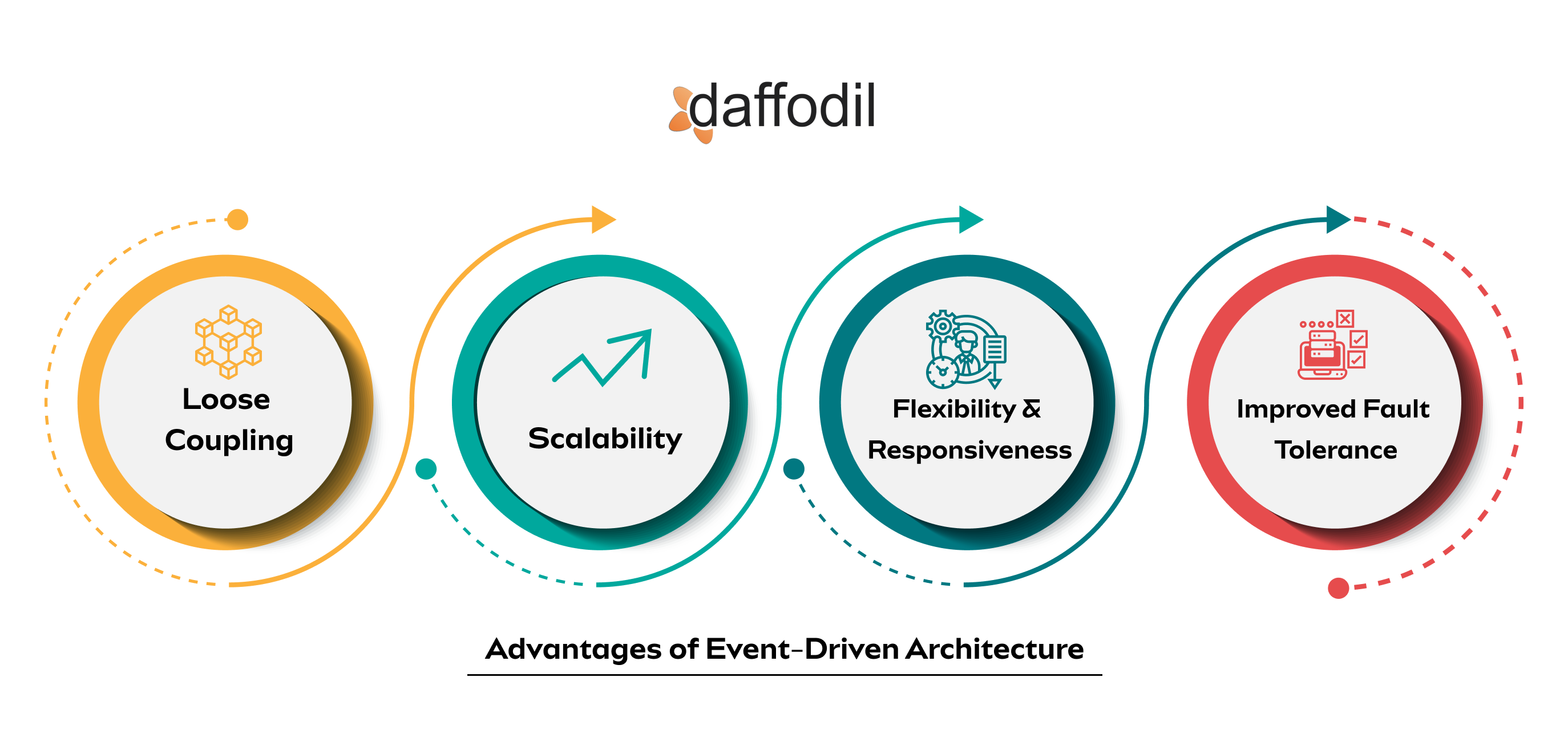
Loose Coupling: Components are decoupled, meaning they can operate independently. Changes in one component do not necessarily affect others as long as they maintain their event interfaces. This loose coupling enhances modularity, making it easier to develop, test, deploy, and maintain individual components.

Scalability: Event-driven systems are inherently scalable. New components can be added or existing ones can be modified without affecting the entire system. Components can subscribe to specific events, enabling seamless integration of new features or services.
Advantages of Event-driven architecture

Flexibility and Responsiveness: Since components react to events in real-time, systems can be highly responsive to changing conditions, user actions, or external stimuli. This real-time responsiveness is critical in applications where timely actions are necessary, such as financial trading platforms, IoT devices, or online gaming systems.

Improved Fault Tolerance: Due to its decentralized nature, event-driven architecture enhances fault tolerance. If one component fails, it doesn't necessarily disrupt the entire system. Other components can continue processing events, ensuring that critical functions remain operational.


How does Event-Driven Architecture Work?


Event-driven architecture is made up of various components. Here’s a step-by-step explanation of how event-driven architecture works:
how does Event-driven architecture work?

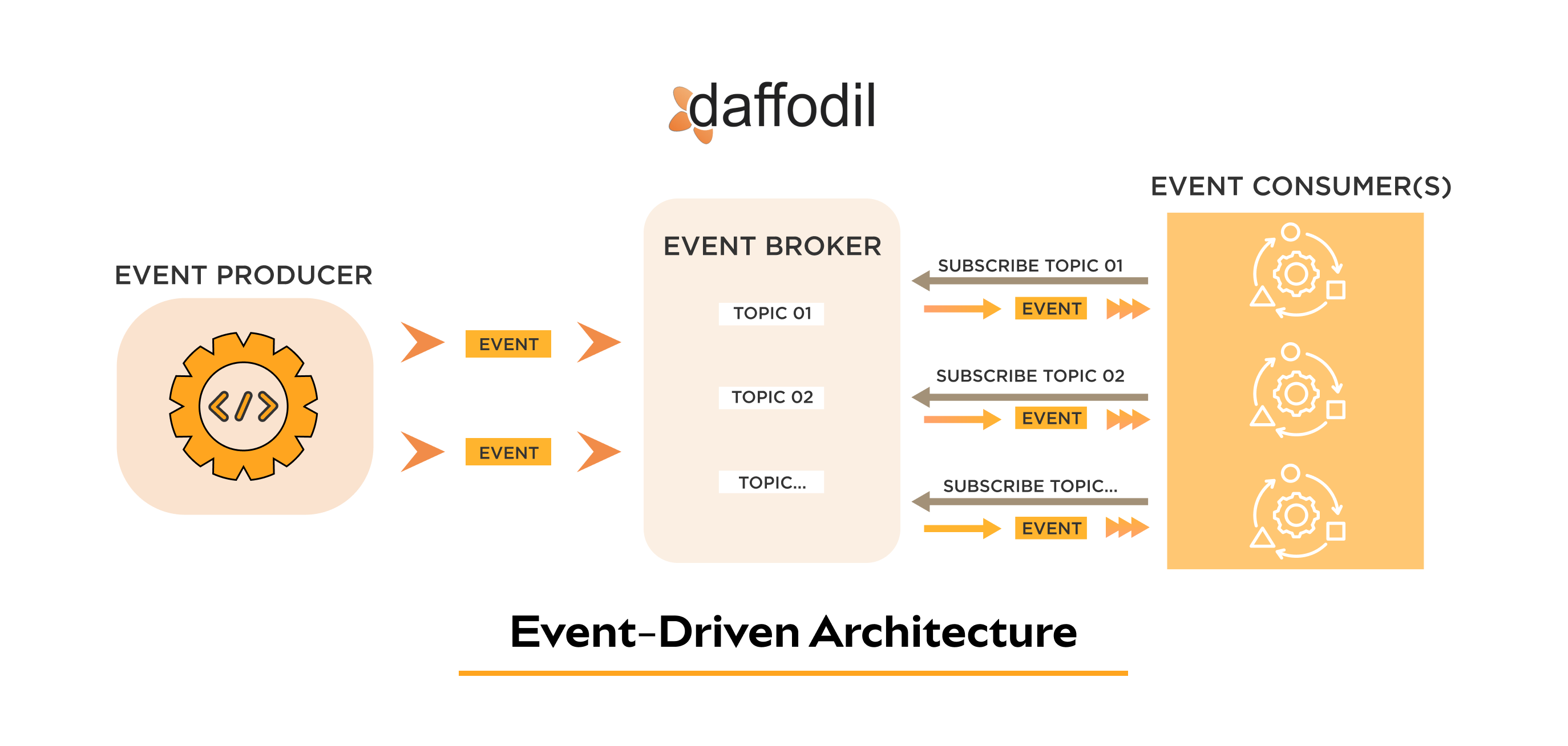
Event Generation (Production): The process begins with various components or systems within the architecture generating events. These could range from user interactions like mouse clicks or button presses to sensor readings, database changes, or system notifications. Events are discrete and specific, capturing a moment of interest within a system.

Event Distribution (Event Channels/Brokers): Events are sent to event channels or brokers. These intermediaries serve as communication hubs. They receive events from event sources and manage the distribution of these events to the appropriate event consumers. Event channels ensure that events are delivered reliably and efficiently to consumers.

Event Consumption: Components or services interested in specific types of events subscribe to those events. By subscribing, these components express their interest in receiving notifications when particular events occur. Subscribing allows components to specify the types of events they want to handle.

So, when an event of interest arrives in the event channel, the event consumer detects the event. This detection is typically done through polling the event channel or, in more advanced systems, through mechanisms like callbacks or webhooks.

Event Processing (Reaction): Upon detecting a relevant event, the event consumer triggers its associated event handler. The event handler contains the logic to process the event. This logic can range from simple tasks, such as updating a database or sending a notification, to complex operations involving multiple components and services. Event handlers define how the system responds to specific events.

Asynchronous Processing: Importantly, the entire process is asynchronous. Events are processed independently of the main flow of the program. This asynchronicity enables near real-time  responsiveness, allowing components to react to events without waiting for the completion of other tasks.

Feedback Loop: After processing an event, components might generate new events, creating a feedback loop. These new events can trigger further actions in other parts of the system, leading to a chain reaction of event generation, distribution, and processing.


How it Actually Works: Example Architecture


Here's an example of an event-driven architecture for a ride-sharing platform like Uber. The system includes components such as passenger apps, driver apps, a payment system, and a dispatch service. Events in this system can represent various interactions and state changes.

1. Event Generation

Event: A passenger requests a ride.

Event Source: Passenger app generates a "RideRequested" event.

2. Event Distribution

The "RideRequested" event is sent to the event channel or broker, where different components are listening.

3. Event Subscription

The Driver app and the Dispatch service have subscribed to "RideRequested" events.

4. Event Detection

The Driver app and the Dispatch service detect the "RideRequested" event as they are subscribed to this event type.

5. Event Processing (Event Handling)

In the Driver App:

Event: Driver accepts the ride request.

Event Source: Driver app generates a "RideAccepted" event.

In the Dispatch Service: The dispatch service processes the "RideRequested" event, finding an available driver and sending a "RideAssigned" event to the respective driver.

6. Asynchronous Processing

The processing of events is asynchronous. While the events are being processed, both the passenger and driver apps remain responsive for new interactions.

7. Feedback Loop and Event Cascading

Event: Driver arrives at the passenger's location.

Event Source: Driver app generates a "DriverArrived" event.

Event Processing: Passenger app receives the "DriverArrived" event and notifies the passenger.

Event: Ride is completed.

Event Source: Driver app generates a "RideCompleted" event.

Event Processing: Payment service receives the "RideCompleted" event and processes the payment.

In this example, event-driven architecture allows the ride-sharing system to respond to various events in real-time, ensuring efficient communication and coordination between different components of the application. The loosely coupled nature of event-driven architecture enables the system to handle a high volume of events and interactions, providing a seamless experience for both passengers and drivers.
Daffodil's success story

Top 5 Models of Event-Driven Architecture 


EDA is a versatile approach, and there are various models within EDA that can be applied based on specific requirements. Here are some common event-driven architecture models:

1) Publish/Subscribe Model

In this model, event sources (publishers) send events to a central event broker. Interested components (subscribers) subscribe to specific types of events. When a matching event is published, the broker forwards the event to all interested subscribers. This decouples the event producers from consumers, allowing for a scalable and flexible system.

2) Event Sourcing

Event sourcing is a model where the state of an application is determined by a sequence of events. These events represent all changes to the system state. The application's state can be reconstructed at any point by replaying the events. This model is particularly useful in systems requiring audit trails, versioning, or complex business logic.

3) Event Collaboration

Event collaboration is a model where multiple services collaborate by exchanging events. Each service is responsible for a specific business capability and communicates with other services through events. Events represent business transactions or domain-specific actions, enabling the system to evolve and adapt to changing business requirements.

4) EDA with Stream Processing

In this model, real-time event streams are processed using stream processing technologies. Events flow through pipelines where they can be filtered, transformed, aggregated, or joined with other streams. This model is highly useful for applications requiring complex event processing, analytics, or real-time monitoring.

5) EDA with Complex Event Processing (CEP)

Complex Event Processing involves analyzing and correlating multiple events to infer patterns or detect complex conditions. This model is suitable for applications where events need to be analyzed in real-time to trigger actions based on specific event patterns or sequences.

Each of these models has specific use cases and advantages, and the choice of a particular model depends on the nature of the application, its requirements, and the desired system behavior. Often, a combination of these models is employed to create robust and adaptive event-driven architectures.
talk to our experts

Event-Driven Architecture vs. Microservices: Key Differences


1) Communication Paradigm: EDA emphasizes asynchronous communication through events, while microservices use APIs for communication, which can be both synchronous and asynchronous.

2) Granularity: Microservices focus on breaking down the application into small, independent services, while EDA focuses on events triggering reactions across components, which can include microservices.

3) Data Consistency: Handling data consistency in microservices architecture can be complex, especially in distributed transactions. EDA, in contrast, doesn’t necessarily deal with data consistency issues since events represent notifications of what has happened rather than enforcing immediate data changes.

4) Use Cases: EDA is particularly useful for real-time systems where responsiveness to events is critical. Microservices architecture is beneficial in large-scale applications where modularity, scalability, and independent development and deployment are essential.

In practice, these patterns can be complementary. An event-driven system might utilize microservices internally to handle specific functionalities, and microservices might communicate through events to achieve loose coupling and real-time responsiveness in certain scenarios. The choice between EDA and microservices often depends on the specific requirements and characteristics of the application being developed.

For example, in an e-commerce platform, a microservice responsible for order processing might be listening to events related to successful payments. When a payment is confirmed (an event), this microservice processes the order, updating inventory and notifying the shipping service. Here, EDA is used within the order processing microservice to handle events, while microservices architecture is employed at a broader level to structure the entire e-commerce system into manageable, independent services.


READ MORE: What is event-driven automation and why do you need it?

Building Responsive Systems for Your Business


By embracing EDA, businesses position themselves to not only meet but exceed the expectations of today's dynamic market. It's not just a technical framework; it's a business enabler. EDA empowers organizations to transform data into actionable insights swiftly, ensuring timely responses to market shifts and customer needs.

According to the report's statistics, an overwhelming 85% of organizations acknowledge the significant business value of integrating EDA into their operations. Nevertheless, the majority are in the early stages of implementation, as only 13% assert they have achieved comprehensive EDA maturity.

Is the lack of real-time data exchange causing workflow interruptions? Our Integration Services, specifically designed for Event-Driven Architecture, bridge these gaps. We ensure your systems communicate seamlessly, processing events in real-time and harmonizing your workflow.

Schedule a no-obligation call

Topics: Software Development Software Architecture

Nikita Sachdeva

Written by Nikita Sachdeva

Nikita is a B2B research analyst who conducts market research around the most cutting-edge technological solutions such as Salesforce, Cloud, Data Enrichment, AI, etc. She is a techno-optimist who brings unique perspectives gained from her experience to the organization and aims to disseminate knowledge to others. When she's not writing, she can usually be found watching sci-fi anime or reading webtoons.

[fa icon="linkedin-square"]

Previous Post

previous_post_featured_image

SAFe vs LeSS vs DaD: Comparing the Three Frameworks to Scale Agile

Next Post

next_post_featured_image

What are Language Models in NLP?

Stay Ahead of the Curve with Our Weekly Tech Insights

  • Recent
  • Popular
  • Categories

Lists by Topic

  • Artificial Intelligence (200)
  • Software Development (182)
  • Mobile App Development (169)
  • Healthcare (141)
  • DevOps (80)
  • Digital Commerce (64)
  • Web Development (59)
  • CloudOps (54)
  • Digital Transformation (37)
  • Fintech (37)
  • Software Architecture (31)
  • UI/UX (31)
  • On - Demand Apps (26)
  • Internet of Things (IoT) (25)
  • Open Source (25)
  • Outsourcing (24)
  • Blockchain (22)
  • Technology (22)
  • Newsroom (21)
  • Salesforce (21)
  • Software Testing (21)
  • StartUps (17)
  • Customer Experience (15)
  • Voice User Interface (14)
  • Robotic Process Automation (13)
  • Javascript (11)
  • OTT Apps (11)
  • Big Data (10)
  • Business Intelligence (10)
  • Data Enrichment (10)
  • Infographic (10)
  • Education (9)
  • Microsoft (6)
  • Real Estate (5)
  • Banking (4)
  • Game Development (4)
  • Agentic AI (3)
  • Enterprise Mobility (3)
  • Hospitality (3)
  • Coding (2)
  • Generative AI (2)
  • eLearning (2)
  • Context Engineering (1)
  • Public Sector (1)
  • Software Engineering (1)
  • cloud migration (1)
  • database migration (1)
see all

Posts by Topic

  • Artificial Intelligence (200)
  • Software Development (182)
  • Mobile App Development (169)
  • Healthcare (141)
  • DevOps (80)
  • Digital Commerce (64)
  • Web Development (59)
  • CloudOps (54)
  • Digital Transformation (37)
  • Fintech (37)
  • Software Architecture (31)
  • UI/UX (31)
  • On - Demand Apps (26)
  • Internet of Things (IoT) (25)
  • Open Source (25)
  • Outsourcing (24)
  • Blockchain (22)
  • Technology (22)
  • Newsroom (21)
  • Salesforce (21)
  • Software Testing (21)
  • StartUps (17)
  • Customer Experience (15)
  • Voice User Interface (14)
  • Robotic Process Automation (13)
  • Javascript (11)
  • OTT Apps (11)
  • Big Data (10)
  • Business Intelligence (10)
  • Data Enrichment (10)
  • Infographic (10)
  • Education (9)
  • Microsoft (6)
  • Real Estate (5)
  • Banking (4)
  • Game Development (4)
  • Agentic AI (3)
  • Enterprise Mobility (3)
  • Hospitality (3)
  • Coding (2)
  • Generative AI (2)
  • eLearning (2)
  • Context Engineering (1)
  • Public Sector (1)
  • Software Engineering (1)
  • cloud migration (1)
  • database migration (1)
see all topics

Elevate Your Software Project, Let's Talk Now

Delaware, USA

3500, South Dupont Highway Dover, DE 19901 USA

Contact +1 518 676 2958

London, UK

124 City Road, EC1V 2NX, London, UK

Contact +1 518 676 2958

Dubai, UAE

407- 412, Clover Bay Tower, Business Bay, Dubai, UAE

Contact +1 518 676 2958

Gurugram, India

9th Floor, Tower B1, DLF SEZ Silokhera, Sec 30, Gurgaon 122001

Contact +91 124 681 7000


Discover Daffodil
  • About Us
  • Leadership
  • Partners
  • Career & culture
  • Corporate social responsibility
  • Daffodil Software Reviews
  • Privacy Policy
Industries
  • Healthcare
  • Software technology
  • Fintech
  • Banking
  • Real Estate
  • Travel & Logistics
  • Public Sector
  • Media & Entertainment
  • Food & Beverages
Services
  • Software Engineering Services
  • Product Discovery Services
  • Software Development Services
  • Software Testing Services
  • Managed Cloud Services
  • Software Support & Maintenance
  • Smart Teams
  • Hire Software Developers
  • Technology Consulting
  • Robotic Process Automation
  • Legacy Modernisation
  • Enterprise Mobility Services
Domain Expertise
  • Mobile App Development
  • UI/UX Design Services
  • DevOps
  • Cloud Services
  • Artificial Intelligence
  • Digital Commerce Solutions
  • IoT Solutions
  • eLearning Solutions
  • Business Intelligence
  • Performance Marketing
  • Data Enrichment
  • OTT Platforms
  • Managed IT Services
  • Application Security
Follow Us On
  • facebook
  • linkedin
  • youtube
  • x
Get In Touch

E-mail us at: info@daffodilsw.com

ftr-daffodil-logo
CMMI-Level-3

A CMMI level 3 Company

© Daffodil Unthinkable Software Corp. 2026 - All Rights Reserved