




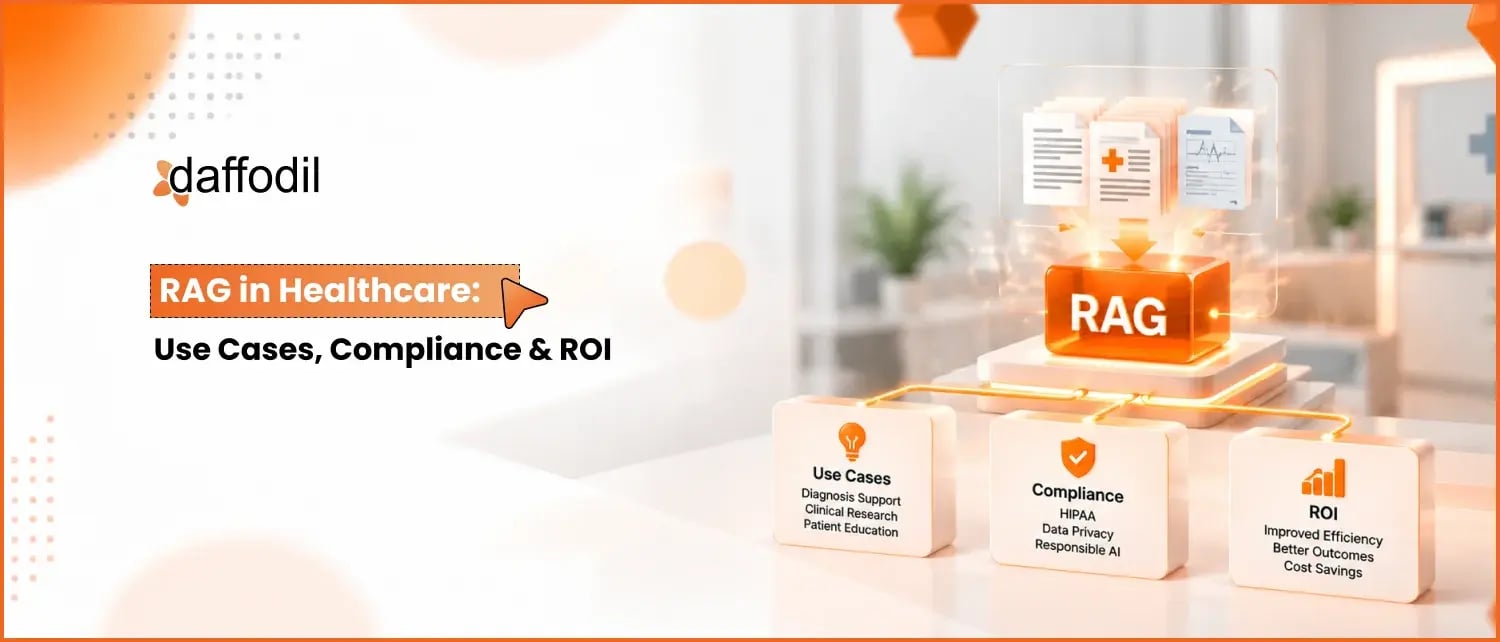
What Is RAG in Healthcare?
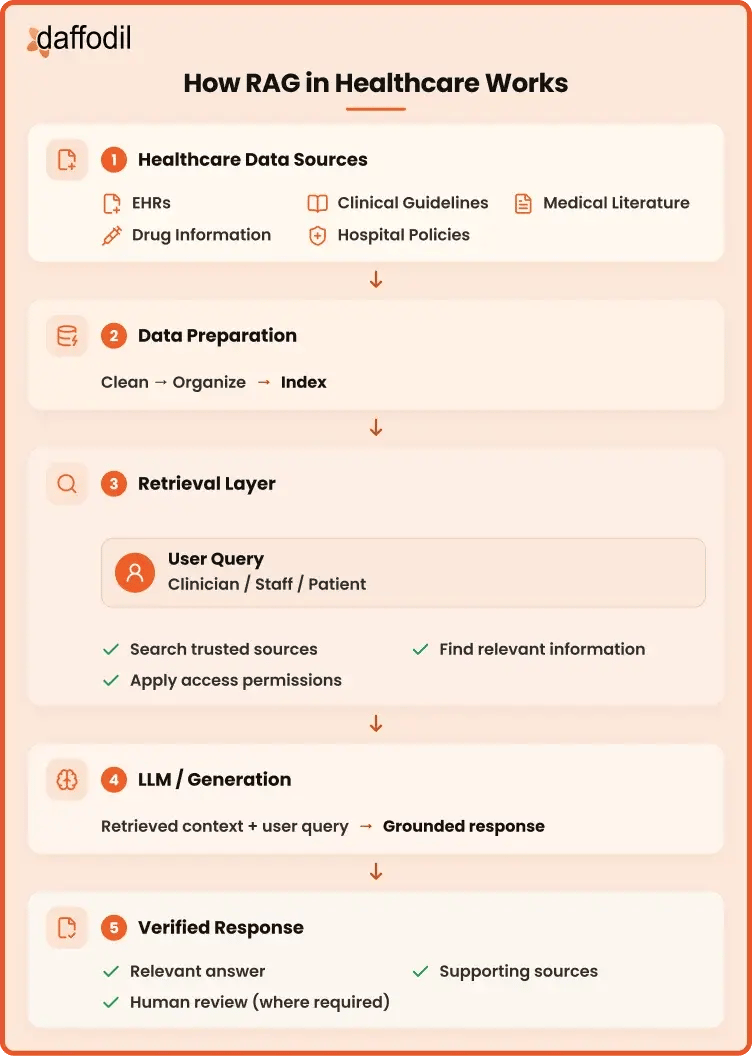
Retrieval-augmented generation, or RAG in healthcare, is an approach that allows a generative AI system to find relevant information from trusted healthcare sources before creating a response. Instead of depending only on what the model learned during training, it can retrieve information from sources such as clinical guidelines, medical literature, electronic health records (EHRs), internal policies, and approved medical databases.
As, healthcare organizations manage large amounts of information across electronic health records (EHRs), clinical notes, medical literature, treatment guidelines, and internal policies. RAG in healthcare connects generative AI solutions with trusted healthcare data sources, allowing systems to retrieve relevant information before generating a response.
A 2025 systematic review of 20 biomedical studies found that RAG improved the performance of large language model applications compared with baseline models, while highlighting the need for careful clinical evaluation. This is especially important when healthcare RAG systems handle sensitive patient data or support high-risk workflows.
Example:
Mayo Clinic's Surgery AI Lab, which is developing RAG-powered virtual assistants for surgical patients. These assistants use approved medical information to provide more relevant responses to common questions about postoperative care. Mayo Clinic researchers are also testing RAG with trusted medical sources for clinical knowledge retrieval and other healthcare applications.
Some of the benefits of RAG in Healthcare are:
- Faster Access to Healthcare Information: RAG can quickly find relevant information across medical records, clinical guidelines, research, and other approved sources, reducing manual search.
- More Relevant Responses Using Approved Sources: Responses can be based on trusted healthcare sources selected by the organization, making the information more relevant to the user's question.
- Easier Updates When Medical Knowledge Changes: Healthcare organizations can update the information available to the system as clinical guidelines, research, policies, and other medical knowledge change.
- Better Use of Existing Healthcare Data: RAG can help healthcare teams find and use information already available across EHRs, clinical notes, reports, and internal documents.
- Source Visibility and Easier Verification: RAG can provide supporting sources with its responses, helping healthcare professionals review where the information came from before using it.
What are the Use Cases of RAG in Healthcare
RAG can help healthcare teams find relevant information across EHRs, clinical guidelines, medical literature, drug information, and internal policies. It is one of several generative AI use cases in healthcare, but is especially useful when responses need to be grounded in approved sources.
| Healthcare Use Case | Information RAG Can Retrieve | Potential Value | Human Review |
| Clinical decision support | Patient data + guidelines | Faster evidence access | Required |
| Patient record search | EHR/clinical notes | Less manual searching | Required |
| Documentation | Clinical records | Reduced documentation work | Required |
| Research | Medical literature | Faster research retrieval | Recommended |
| Patient support | Approved patient resources | Faster answers | Based on risk |
| Medication information | Drug databases + patient context | Easier information access | Required |
| Administrative workflows | Policies + documents | Less manual lookup | Based on workflow |
| Knowledge management | Internal healthcare resources | Faster staff search | Based on use |
Its value varies by use case, from clinical decision support and documentation to patient communication and administrative workflows. Research on RAG for clinical decision support also highlights the need for careful testing, as retrieving relevant information does not guarantee a correct response.
Below are 8 key RAG use cases in healthcare and how they can support different clinical, patient-facing, and administrative workflows:
1. Clinical Decision Support
Clinical decision-making often requires clinicians to review patient information alongside clinical guidelines, treatment protocols, and medical literature. RAG in healthcare can bring relevant information from these approved sources into one response, helping clinicians review supporting evidence without searching across multiple resources.
Example:
OpenEvidence is a physician-facing clinical question-answering platform that uses retrieval-augmented generation to provide answers grounded in curated medical sources with citations. A recent systematic review of studies evaluating the platform found that OpenEvidence generally produced clinically relevant, evidence-supported responses, with stronger performance in guideline-based questions, although results varied in more complex clinical scenarios.
What RAG can retrieve:
- Clinical guidelines and treatment protocols
- Peer-reviewed medical literature
- Relevant patient information, where permitted
- Organisation-specific clinical resources
Practical value:
- Faster access to relevant evidence
- Less time spent searching across separate sources
- Easier review of the information supporting a response
2. EHR and Patient Record Search
Patient records can contain years of clinical notes, diagnoses, laboratory results, imaging reports, medication history, and discharge summaries. Finding information relevant to a specific question can require clinicians and staff to search multiple records and documents. RAG in healthcare can make this process more focused by retrieving the relevant parts of an EHR or patient record and using them to answer a specific question or create a summary.
Example:
A 2026 study using real-world EHR data evaluated a RAG-based approach for identifying patients with dementia. By retrieving relevant information from longitudinal patient records, the approach achieved an F1 score of 0.933, compared with 0.823 for a rule-based approach. The study shows how RAG can help extract relevant information from large patient records without processing the entire record at once
What RAG can retrieve:
- Clinical notes and patient history
- Laboratory and imaging reports
- Diagnoses and procedures
- Medication records
- Discharge summaries
Practical value:
- Faster access to relevant patient information
- Less time spent searching through long records
- Easier review of information spread across different documents
- Better support for workflows that require patient-specific context
3. Clinical Documentation and Summarization
Clinical documentation can take significant time, particularly when clinicians need to capture information from patient conversations accurately and structure it into clinical notes. RAG in healthcare can help by retrieving relevant information from the clinical conversation and supporting the creation of structured documentation that clinicians can review and edit.
Example:
Abridge converts patient-clinician conversations into structured clinical notes and links parts of the note back to the relevant conversation, allowing clinicians to review the supporting information. It is used across more than 150 health systems, while studies at Intermountain Health and Samaritan Health reported reductions in documentation time after adoption.
What RAG can retrieve:
- Patient-clinician conversations
- Clinical notes and encounter information
- Medical terminology and clinical context
- Relevant patient history
Practical value:
- Less time spent writing notes
- More structured clinical documentation
- Easier review of generated information
- Reduced documentation burden for clinicians
4. Medical Research and Knowledge Search
Medical researchers often need to search across a large and constantly growing body of research papers, clinical studies, and other scientific literature. RAG in healthcare can make this process more focused by retrieving relevant research based on a question and using those sources to provide an answer or summary.
Example:
MedRAGent uses retrieval-augmented generation to help identify and screen relevant medical studies, addressing a process that normally requires researchers to build search queries and review large numbers of papers manually.
What RAG can retrieve:
- Medical research papers
- Clinical studies and systematic reviews
- Findings related to a specific research question
- Evidence from selected medical databases
Practical value:
- Faster literature discovery
- Less manual searching across large collections of papers
- Easier access to relevant evidence
- Support for literature screening and evidence synthesis
Also Read: Building an AI-Assisted Medical Research Platform
5. Patient Support and Healthcare Assistants
Patients often need information about appointments, hospital services, care instructions, and follow-ups. RAG in healthcare can retrieve this information from approved sources to provide focused answers. For more advanced support, AI agents in healthcare can combine information retrieval with tasks such as appointment coordination and patient engagement.
Example:
A healthcare provider can use a RAG-powered assistant to answer questions about appointment preparation, hospital services, follow-up instructions, or approved patient education resources. The system can retrieve information from the provider's approved content before preparing a response, helping keep answers connected to the information the organization has provided.
What RAG can retrieve:
- Appointment and hospital service information
- Pre-visit and post-visit instructions
- Approved patient education materials
- Follow-up and care instructions
- Hospital and clinic information
Practical value:
- Faster access to approved healthcare information
- Less time spent searching across different resources
- More consistent responses to common patient questions
- Support for patient communication outside regular staff interactions
6. Medication and Drug Information
Healthcare professionals often need to check drug information, prescribing guidelines, medication history, and safety information from multiple sources. RAG in healthcare can retrieve relevant information from approved drug databases, clinical guidelines, and patient records to make this information easier to find and review.
Example:
A RAG-based system can help a clinician find information about a medication, such as its approved uses, dosage guidance, known interactions, or relevant patient medication history. The retrieved information can then be reviewed by the healthcare professional before making a clinical decision.
What RAG can retrieve:
- Drug information and prescribing guidelines
- Medication history
- Drug interaction information
- Medication safety guidance
- Approved clinical protocols
Practical value:
- Faster access to medication information
- Less time spent searching across different sources
- Easier review of relevant medication history
- Better access to approved drug and safety information
7. Medical Coding and Administrative Workflows
Medical coding, billing, and prior authorization teams often need to search through payer policies, clinical documents, coding guidelines, and other administrative information. RAG in healthcare can retrieve the information relevant to a specific task, helping teams find the right information without searching through multiple sources manually.
Example:
Humata Health platform matches changing payer policies with clinical information, determines authorization requirements, and helps prepare and manage prior authorization requests. R1 reported that Humata can support up to a 96% first-pass approval rate, along with a 30% reduction in write-offs, 83% fewer rescheduled appointments, and 45% fewer staff touches. R1 announced its agreement to acquire Humata Health in August 2026.
What RAG can retrieve:
- Payer policies and requirements
- Clinical documentation
- Medical coding guidelines
- Medical necessity information
- Prior authorization requirements
Practical value:
- Faster access to payer and coding information
- Less manual searching and data entry
- Easier preparation of prior authorization requests
- Better access to information needed for administrative decisions
- Fewer delays caused by missing or incomplete information
8. Internal Healthcare Knowledge Management
Healthcare organizations manage large amounts of internal information, including clinical protocols, standard operating procedures, compliance policies, training materials, and department guidelines. RAG in healthcare can retrieve relevant information from these approved sources and provide staff with focused answers without requiring them to search through multiple documents.
Example:
A hospital can use a RAG-based internal knowledge assistant to help staff find information about a clinical procedure, workplace policy, equipment guidelines, or compliance requirement. The system can retrieve the relevant section from approved internal documents and provide it for the employee to review.
What RAG can retrieve:
- Clinical protocols and procedures
- Standard operating procedures (SOPs)
- Compliance and workplace policies
- Staff training materials
- Equipment and department guidelines
Practical value:
- Faster access to internal information
- Less time spent searching through documents
- Easier access to the latest approved policies
- More consistent access to organizational knowledge
- Support for staff training and day-to-day workflows
Across these 8 RAG use cases in healthcare, the goal is to make trusted information easier to find and use. The level of review and security should depend on the use case, especially when patient care, medication, or clinical decisions are involved.
Healthcare RAG Compliance and Security Requirements
Healthcare RAG compliance depends on how patient and health information is collected, stored, retrieved, shared, and used across the complete system. Using RAG does not automatically make an application HIPAA, GDPR, or other healthcare regulation compliant. Many organizations bring in healthcare compliance consulting early so these controls are designed into the system rather than retrofitted.
Below are 9 compliance and security requirements healthcare organisations should consider when planning and implementing a RAG system:
1. Protect Patient and Health Information
Healthcare organisations should first identify what patient information the RAG system needs and avoid giving it access to data that is not required for its purpose. Sensitive information should be protected throughout the process, including when it is stored, retrieved, sent to another service, or included in a generated response.
For U.S. organizations subject to HIPAA, the HIPAA Security Rule requires appropriate administrative, physical, and technical safeguards for electronic protected health information (ePHI).
Also Read: HIPAA-Compliant AI Technical Implementation Guide
2. Control Who Can Access What
Not every user should be able to retrieve the same healthcare information. Access should depend on the person's role and what information they need to perform their work. A staff member who cannot normally access a patient's clinical record should not be able to retrieve that information indirectly by asking the RAG assistant.
This is an important RAG-specific risk. The European Data Protection Supervisor warns that RAG systems connected to sensitive repositories can expose personal information when users retrieve information they should not be able to access.
For example, access can be based on the user's role:
- Clinician: Patient records, clinical notes, lab results
- Administrative staff: Policies, procedures, operational documents
- Billing staff: Billing and insurance information
- IT staff: System and technical documentation
These permissions should also apply to the information the RAG system can search, not just the application itself.
3. Keep Records of Data Access and System Activity
Healthcare organizations need visibility into how the system is being used. Records should capture important activities such as who accessed sensitive information, what sources were retrieved, and important actions taken through the system.
These records can help organizations investigate security incidents, review inappropriate access, and understand how the system handled sensitive information. HIPAA's Security Rule includes audit-control requirements for systems that contain or use ePHI
4. Encrypt Sensitive Information
Patient and health information should be protected when it is stored and when it moves between healthcare systems, databases, applications, and external services. Encryption can reduce the risk of sensitive information being readable if it is accessed without authorization. Encryption is one part of a wider healthcare cybersecurity strategy that should cover every system the RAG pipeline touches.
The exact controls should be based on the organization's risks and applicable requirements. Under the currently effective HIPAA Security Rule, encryption is an addressable implementation specification, meaning organizations must assess whether it is reasonable and appropriate and document alternatives when applicable.
5. Control What Information Can Be Retrieved
A healthcare RAG system should not search every connected source for every user request. Organizations need clear rules around which data sources can be searched, which information can appear in responses, and which users can retrieve sensitive data.
A healthcare RAG system should have clear rules for:
- Which data sources each user can search
- What information can appear in a response
- Which users can access sensitive patient information
This becomes particularly important when the same system connects to EHRs, clinical guidelines, internal policies, and other healthcare databases. Retrieval permissions should follow the user's existing access rights rather than creating a new path around them.
6. Review Third-Party Models and Services
Many healthcare RAG systems depend on external model providers, cloud platforms, databases, or other technology services. Before sensitive information is shared with a third party, healthcare organizations should understand where the data goes, how it is stored and used, how long it is retained, and what security controls apply. Using HIPAA-compliant cloud
services for hosting, storage, and vector databases can simplify this review.
For organizations covered by HIPAA, third parties handling PHI may also have business-associate responsibilities. HHS states that covered entities and business associates using a cloud service provider that handles PHI need appropriate assurances through a Business Associate Agreement where applicable.
7. Keep Human Review for High-Risk Decisions
RAG can provide clinicians with relevant information, but retrieved sources or generated responses can still be incomplete or incorrect. Clinical decisions involving diagnosis, treatment, medication, or other high-risk areas should therefore have appropriate professional review.
The level of human involvement can vary by use case. An internal policy-search tool may require less oversight than a system providing information that could influence patient care.
- Lower risk: hospital FAQs, internal policy search, staff knowledge search.
- Higher risk: diagnosis support, medication information, treatment recommendations, patient-specific clinical guidance.
8. Test Responses Before and After Launch
Testing should cover more than whether the system can answer a question. Healthcare teams should check whether it retrieves the correct sources, produces accurate responses, respects access permissions, handles sensitive information properly, and responds safely when the required information is unavailable.
Testing should also continue after launch. Healthcare information, connected data, user behaviour, and system components can change over time, so quality and security need ongoing monitoring.
9. Plan for Different Healthcare Regulations
Healthcare RAG compliance requirements vary by region and depend on the type of health data being handled and how the system is used. The table below highlights key regulations and requirements healthcare organisations should consider when planning a RAG system.
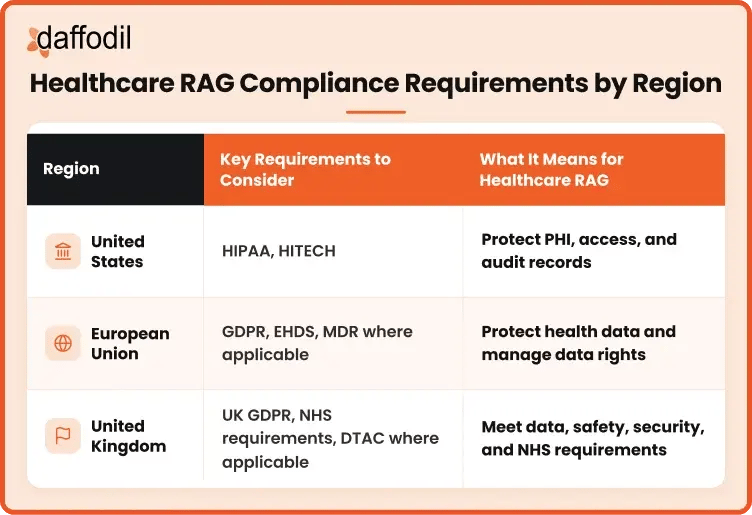
Note: These requirements should be reviewed based on the specific use case, location, and data involved. Organizations operating across multiple regions may also need to meet more than one set of requirements, making compliance an important part of RAG planning from the beginning.
Also Read: Regulations and Compliance in Healthcare Application Development
6 Steps to Implement RAG in a Healthcare System
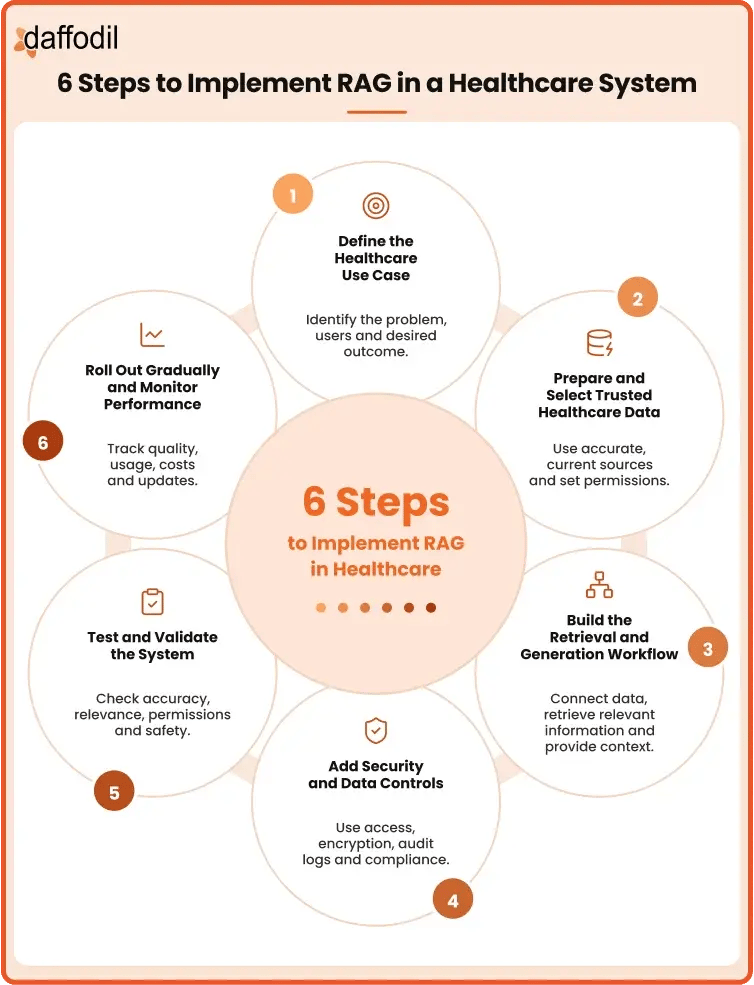
Implementing RAG in healthcare should begin with a specific problem rather than trying to connect every healthcare system and data source at once. A focused implementation makes it easier to test retrieval quality, protect sensitive data, and understand whether the system is actually improving the workflow.
Step 1. Define the Healthcare Use Case
Start by identifying the exact problem the RAG system needs to solve. This could be finding information across patient records, searching clinical guidelines, supporting medical research, or helping staff access internal healthcare knowledge.
At this stage, define who will use the system, what information they need, and what a successful outcome should look like.
Step 2. Prepare and Select Trusted Healthcare Data
Identify the information required for the selected use case and check whether it is accurate, current, and suitable for retrieval. Depending on the application, sources may include EHR data, clinical guidelines, medical literature, hospital policies, or approved knowledge bases.
The team should also determine:
- Which sources the system is allowed to access
- Who has permission to access each source
- How outdated or incorrect information will be updated or removed
Also Read: Building A Scalable Data Management Platform For A US-Based Clinical Research Leader
Step 3. Build the Retrieval and Generation Workflow
The next step is to connect approved healthcare data with the retrieval system and language model. The workflow should:
- Prepare healthcare documents for retrieval
- Retrieve only relevant information for each query
- Pass the retrieved information to the model as context
- Apply access controls to protect sensitive data
The goal is to provide relevant context without sending unnecessary healthcare data to the model. Organizations that need external engineering support can also evaluate healthcare software development companies that have experience with healthcare data, integrations, security, and regulated healthcare environments.
Step 4. Add Security and Healthcare Data Controls
Security should be built into the implementation rather than added before launch. Access permissions should apply not only to the application but also to the information that can be retrieved.
Important controls include authentication, role-based access, encryption, audit logs, retrieval permissions, and appropriate handling of PHI or other sensitive health information. These controls should align with the compliance requirements that apply to the organization and its use case.
Step 5. Test and Validate the Healthcare RAG System
Before wider deployment, test the system with realistic healthcare scenarios and information. Testing should check whether it:
- Retrieves the correct and most relevant sources
- Produces responses supported by those sources
- Respects user and data-access permissions
- Handles missing or conflicting information appropriately
- Avoids exposing sensitive patient information
Clinical or other high-risk applications should also be evaluated by qualified healthcare professionals before their responses are used in real workflows. Specialized AI application
testing can help validate retrieval accuracy, hallucination rates, and permission handling at
scale.
Step 6. Roll Out Gradually and Monitor Performance
Start with a controlled group of users or a limited workflow before expanding the RAG system across the organization. This allows teams to identify retrieval, usability, security, and response-quality issues in a lower-risk environment.
After launch, monitor retrieval accuracy, response quality, user adoption, response time, system costs, and recurring errors. The underlying healthcare sources should also be reviewed and updated so the system does not continue retrieving outdated information.
A healthcare RAG implementation should therefore be treated as an ongoing system rather than a one-time deployment. Its performance depends not only on the model, but also on the quality of the healthcare data, retrieval process, security controls, testing, and monitoring around it.
How to Measure the ROI of RAG in Healthcare
The ROI of RAG in healthcare depends on the workflow it is designed to improve. A strong data strategy is also important because the quality, accessibility, and organization of healthcare data can directly affect the value an AI system delivers.
A system used for clinical knowledge search will create value differently from one used for patient support or administrative work. Organisations should therefore establish a baseline before implementation and compare it with performance after the RAG system is introduced.
Also Read: Data Strategy for AI Solutions: Why it Matters and How to Build One
1. Measure Time and Manual Work Saved
Start by measuring how much time users spend completing the workflow before and after implementation.
For example, organizations can track:
- Time spent searching clinical documents
- Time spent reviewing patient records
- Time spent finding internal policies
- Time spent gathering information from multiple systems
- Manual steps removed from the workflow
The goal is not simply to show that the RAG system produces answers faster, but that it reduces meaningful manual work for clinicians and staff.
Similar productivity challenges exist in EHR workflows, where AI can help reduce documentation and information-management burdens. See how AI is being used in EHR systems.
2. Track Quality and Accuracy
Faster responses provide little value if users frequently need to correct or verify inaccurate information. Organizations should monitor:
- Whether the system retrieves relevant sources
- Whether responses are supported by those sources
- How often users correct an answer
- How often users reject or do not use the response
- Whether the system can identify when relevant information is unavailable
For clinical applications, quality measures should be defined with healthcare professionals and based on the specific workflow.
3. Measure Response and Resolution Time
For workflows such as patient support, internal knowledge search, or administrative requests, measure whether users can reach the information or complete the task faster.
Instead of tracking response speed alone, organizations should look at time to successful resolution. A quick response that does not solve the user's problem does not represent meaningful ROI.
4. Monitor User Adoption
A technically strong RAG system provides limited business value if clinicians or staff do not use it. Track how many intended users actively use the system, how frequently they return, and which workflows receive the most usage.
Low adoption can also reveal problems with usability, response quality, workflow integration, or user trust.
5. Compare the Value With the Total Cost
The cost side of ROI should include more than model usage. Healthcare organizations should account for:
- Data preparation
- EHR and other system integrations
- Infrastructure
- Model usage
- Security and compliance controls
- Testing and monitoring
- Ongoing maintenance
Ongoing model and infrastructure spend can also be reduced with proven cost optimization practices for generative AI applications. Time saved, reduced manual effort, faster resolution, improved information access, response quality, and user adoption can also help determine whether the RAG implementation is delivering enough value to justify further investment.
What Does It Cost to Implement RAG in Healthcare?
Based on published 2026 estimates, a healthcare RAG implementation can range from roughly $40,000 for a focused custom solution to $500,000 or more for a production deployment with deeper healthcare integrations and compliance requirements. Large enterprise-wide implementations can move beyond this range. Published estimates vary considerably because there is no standard price for healthcare RAG.
- Focused RAG pilot: around $40,000-$150,000
- Production healthcare RAG system: around $150,000-$500,000
- Large enterprise deployment: $500,000+
These figures should be presented as indicative ranges rather than fixed prices, since EHR integrations, healthcare data preparation, security and compliance requirements, number of data sources, and deployment scale can substantially change the final cost.
Conclusion
RAG can help healthcare organizations find and use information from EHRs, clinical documents, medical research, internal policies, and other trusted sources more efficiently. Its use cases range from clinical decision support and patient record search to medical research, documentation, patient support, medication information, and administrative workflows.
However, a successful healthcare RAG system depends on more than the retrieval technology itself. Data quality, reliable sources, security, system integration, human review, and regular monitoring all play an important role.
The best approach is to start with a clear use case, choose the right sources, and define how the system will be reviewed and measured. When implemented with the right controls, RAG can make healthcare information easier to find and use while keeping professionals involved where their judgment is needed.