




AI is moving from experiments to systems. For much of the past decade, AI has lived in a familiar pattern: promising pilots, impressive demos, and isolated wins that hinted at transformation but rarely reshaped core systems. By 2026, that pattern might break. Here’s what tech leaders need to know about scaling AI effectively in 2026.
Table Of Contents
1. Introduction: Why 2026 Is a Turning Point for AI
2. AI Trends for 2026: What Tech Leaders Need to Know
2.1 Agentic AI Moves From Chatbots to Autonomous Systems
2.2 Protocols and Standards Create the Agent Internet
2.3 Multimodal AI Becomes the Default Interface
2.4 Physical AI Crosses From Labs Into Production
2.5 Domain-Specific Models Overtake General-Purpose AI
2.6 Generative AI Evolves Beyond Content Creation
2.7 AI Transforms Software Development Completely
2.8 Human–AI Collaboration Redefines Work
2.9 AI Governance, Security, and Data Trust Become Non-Negotiable
2.10 Operationalizing AI: From Pilots to ROI
3. AI and Quantum Computing: Early Signals of a New Compute Layer
4. What This Means When Choosing a Software Partner
Introduction: Why 2026 Is a Turning Point for AI
For much of the past decade, AI has lived in a familiar pattern: promising pilots, impressive demos, and isolated wins that hinted at transformation but rarely reshaped core systems. By 2026, that pattern might break.
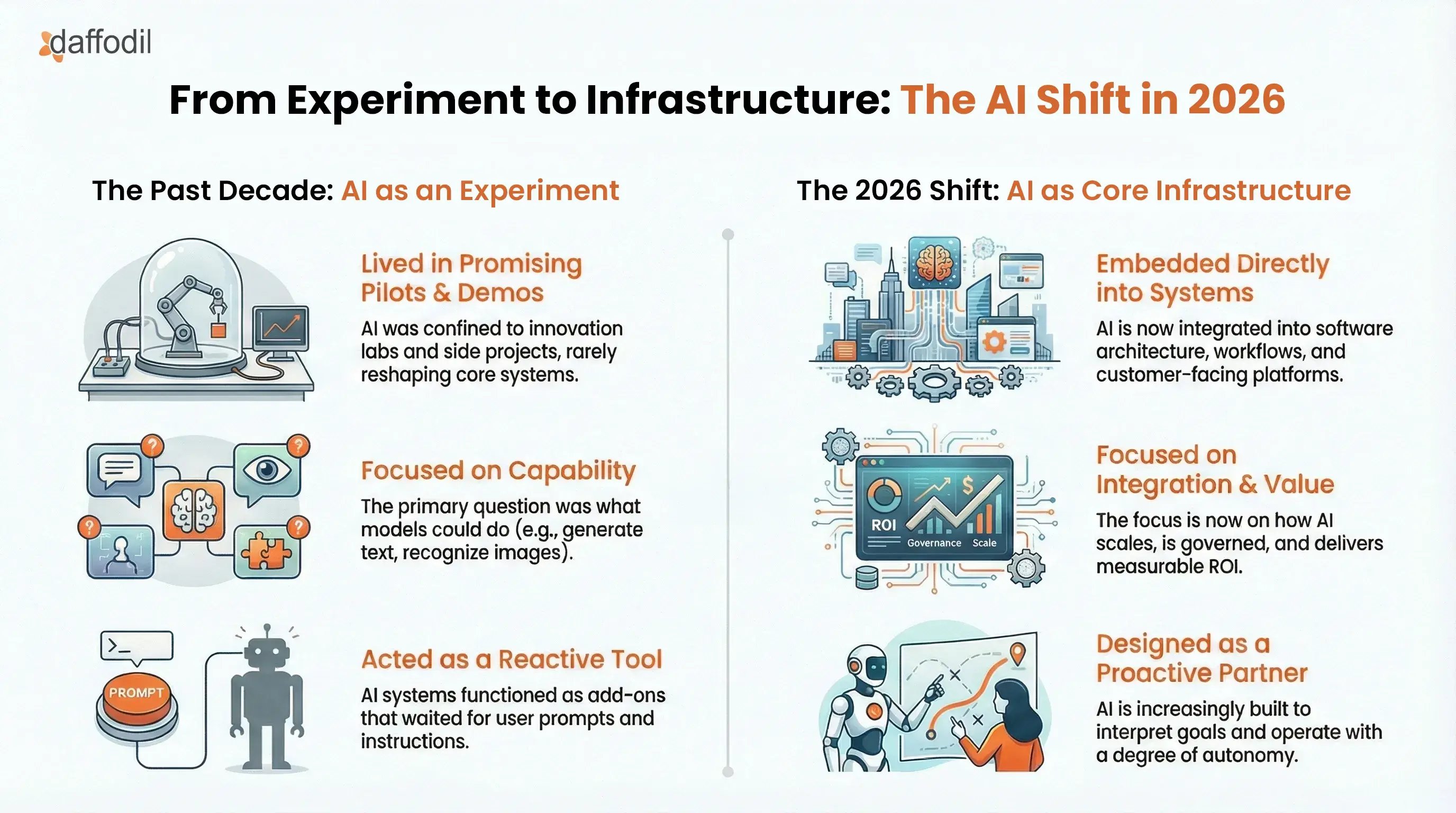
Across companies, AI is no longer confined to innovation labs or side projects owned by small data teams. It is being embedded directly into software architectures, development workflows, operational decision-making, and customer-facing platforms. The shift is subtle but consequential: AI is becoming a core infrastructure, not an add-on. Together, these shifts define the top AI trends in 2026, marking a clear move from experimental tools to operationally embedded systems.
Industry analysts argue that competitive advantage in AI will come less from model scale and more from how intelligence is integrated into systems, as highlighted in recent analysis from MIT Sloan Management Review.
For technology leaders, this moment feels different from previous AI hype cycles. Earlier phases focused on capability: could models generate text, recognize images, or predict outcomes? In 2026, the focus will shift to integration: how AI systems interact with existing platforms, how they scale reliably, how they are governed, and how they deliver measurable value under real-world constraints.
Just as importantly, AI’s role inside companies is changing. Instead of acting as a reactive tool that waits for prompts, AI is increasingly designed to function as a partner, one that can interpret goals, coordinate tasks, and operate across systems with a degree of autonomy. This transition has architectural implications as much as organizational ones, demanding new approaches to software design, data management, and system orchestration.
The top 10 AI trends in 2026 will reflect this reality. They will be less about novelty and more about what AI can deliver in practice.
AI Trends for 2026: What Tech Leaders Need to Know
Understanding the top AI trends in 2026 requires looking beyond individual models and focusing on how AI is engineered into real systems. Below, let’s look at what the top AI trends in 2026 are.
1. Agentic AI Moves From Chatbots to Autonomous Systems
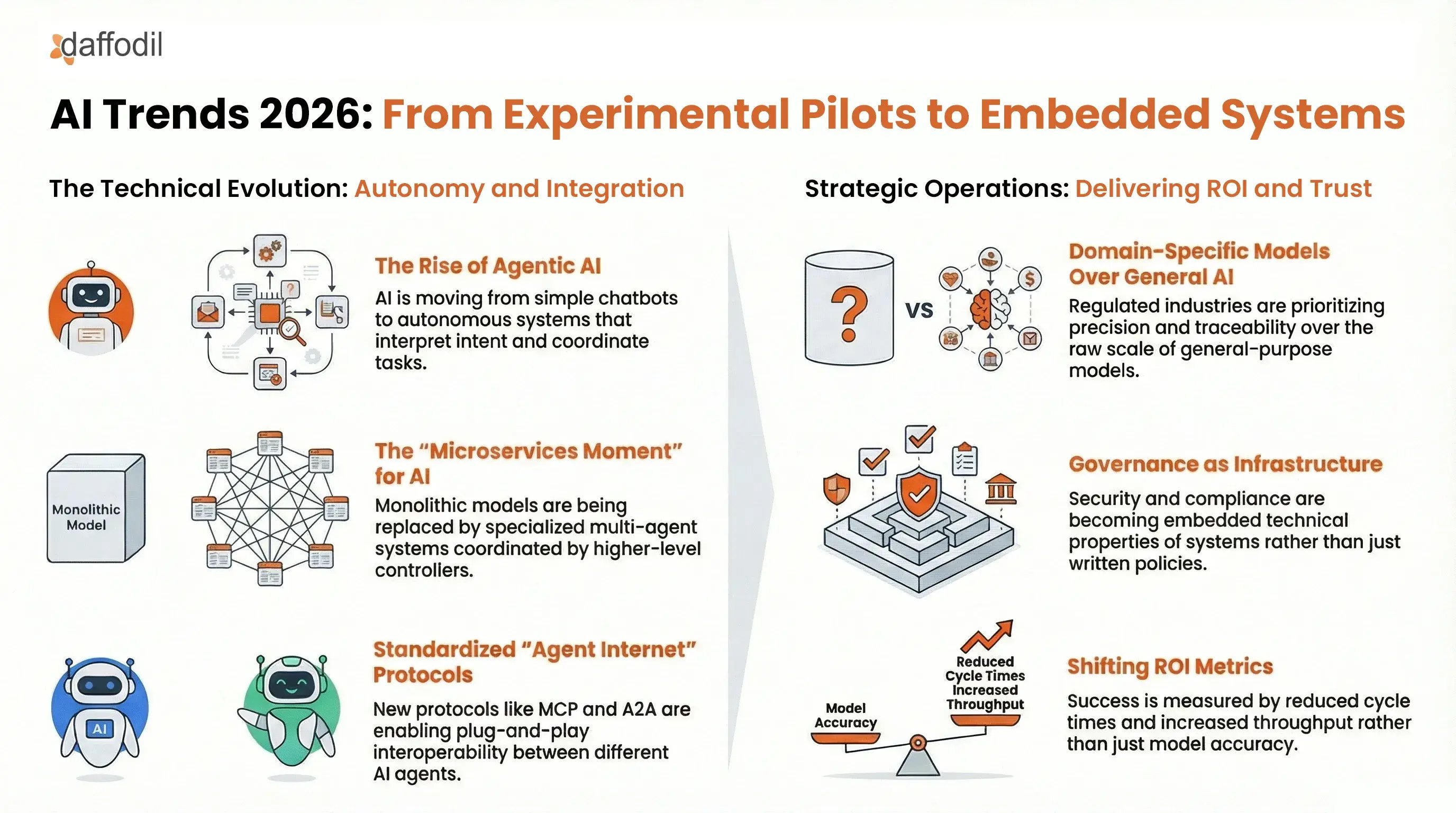
For many organizations, AI’s public breakthrough came in the form of conversational interfaces. Chatbots showed that large models could reason, summarize, and generate with surprising fluency. But by 2026, that chapter might end. The next phase of AI is not conversational, it’s agentic.
Agentic AI refers to systems designed around goals rather than prompts. Instead of waiting for instructions, these systems can interpret intent, plan sequences of actions, and adapt their behavior based on outcomes. The shift is subtle in concept but heavy in execution: AI is no longer just responding to users; it is starting to operate within systems.
This change is already reshaping how modern software is built. Where earlier AI integrations focused on enhancing individual features: search, recommendations, content generation, genetic systems cut across workflows. They connect data sources, coordinate tasks, and operate asynchronously across time and services. In practice, this means AI is coming closer to the role of an orchestrator than a feature.
From Single Agents to Coordinated Multi-Agent Systems
Early agentic tools often relied on a single, general-purpose agent tasked with doing “a bit of everything.” That approach is now showing its limits. As companies push AI into more complex environments, monolithic agents become brittle and difficult to scale.
The emerging pattern in 2026 is multi-agent orchestration: systems composed of specialized agents, each responsible for a discrete function, coordinated by a higher-level controller. This mirrors established software architecture principles, where distributed services replaced monoliths to improve resilience and scalability.
For technology leaders, the implication is clear: agentic AI is less about individual models and more about system design. Questions around coordination, shared context, failure handling, and observability come into the limelight. These are not purely AI challenges; they are software engineering challenges, amplified by autonomy.
The “Microservices Moment” for AI Architecture
Many engineers describe the current phase of agentic AI as its “microservices moment.” The analogy is instructive. Just as microservices introduced flexibility at the cost of increased architectural complexity, agentic systems promise higher levels of automation while demanding stronger foundations.
Without thoughtful orchestration, multi-agent systems can become difficult to reason about. Debugging, governance, and performance monitoring all require new approaches when decision-making is distributed across autonomous components. This is where the role of experienced software partners becomes critical, not to “add AI,” but to design systems that can sustain it.
Human Involvement Becomes Strategic, Not Operational
As autonomy increases, the role of humans changes. In agentic systems, people are no longer micromanaging every action. Instead, they define objectives, set constraints, and oversee outcomes.
This transition introduces both opportunity and risk. Done well, it unlocks efficiency and scale. Done poorly, it creates blind spots and accountability gaps. The difference lies in how agentic systems are designed, particularly how decisions are logged, audited, and overridden if necessary.
In 2026, companies adopting agentic AI are learning a critical lesson: autonomy does not eliminate responsibility. It redistributes it. And that redistribution must be reflected in architecture, governance models, and development practices.
For decision-makers evaluating AI-enabled software partners, agentic AI is an early signal. It shows whether a team understands AI as a surface-level capability or as a systems challenge that demands rigor, discipline, and long-term thinking.
2. Protocols and Standards Create the Agent Internet
As agentic systems proliferate, a new constraint is emerging, not model capability, but communication. In isolated environments, agents can operate effectively with custom logic and tightly coupled integrations. At scale, however, that approach collapses under its own complexity. Interoperability and coordination are emerging as defining characteristics of the top AI trends in 2026, especially as agentic systems scale.
Why Agent-to-Agent Communication Is the Next Bottleneck
Today’s AI agents often operate inside closed systems, woven together through bespoke APIs and hard-coded assumptions. While workable for early deployments, this fragmentation becomes a liability as companies introduce more agents, more tools, and more vendors.
Without shared communication standards, every new agent introduces integration overhead. Context gets lost between systems, behaviors become inconsistent, and governance becomes reactive rather than designed.
For decision-makers, this mirrors an earlier era of enterprise software, before standard protocols enabled systems to reliably talk to one another.
MCP, A2A, and the Rise of Interoperable Agents
The industry is beginning to converge around agent communication protocols, lightweight standards that define how agents exchange context, invoke tools, and collaborate across boundaries.
Protocols such as MCP (Model Context Protocol) and A2A (Agent-to-Agent communication models) aim to do for AI what HTTP and REST did for web services: establish a shared contract for interaction. Instead of custom integrations for every database, API, or workflow, an agent can rely on standardized context schemas to discover tools, request actions, and pass structured state to another agent, even if that agent was built by a different team. This shift enables cross-platform collaboration, where agents are no longer confined to a single stack. For companies, it reduces lock-in and simplifies system evolution over time.
From Custom Integrations to Plug-and-Play AI
The practical impact of standardization is significant. What once required weeks of integration work increasingly becomes configuration. A company might introduce a new compliance agent that immediately understands how to read audit logs, query internal services, and flag anomalies. This is not because it was custom-built for that environment, but because the environment exposes standardized interfaces.
For software partners, this raises the bar. Building agentic systems in 2026 means designing for interoperability from the start, not retrofitting standards after the fact.
Governance, Security, and Trust at the Protocol Layer
Interoperability alone is not enough. As agents gain autonomy and cross system boundaries, protocols must also encode trust. Agent standards increasingly include identity, permissioning, and auditability, treating agents not as anonymous processes, but as first-class actors within a system.
An agent invoking an action may carry a scoped identity, limited permissions, and an immutable activity log. This enables teams to trace decisions, enforce least-privilege access, and revoke capabilities when necessary. This approach reflects a broader realization: safety and governance cannot live alone at the application layer. In agentic systems, they must be embedded into the communication fabric itself.
For companies evaluating AI-enabled software partners, protocol fluency is a signal. It indicates whether a team is building for isolated success or for an ecosystem where AI systems can collaborate and scale.
3. Multimodal AI Becomes the Default Interface
For years, AI systems have been constrained by a narrow input channel: text. Prompts in, responses out. That interaction model was useful, but increasingly misaligned with how work actually happens inside companies. By 2026, multimodal AI is no longer a differentiator. It’s becoming the baseline.
Multimodal systems can ingest and reason across multiple modalities, including text, images, audio, video, and structured data. More importantly, they can connect those inputs into a single decision flow. The result is not just richer outputs, but workflows that reflect the complexity of real operational environments.
Beyond Text: AI That Understands Context, Not Just Commands
Most business processes don’t start with a clean slate. They start with screenshots, dashboards, documents, logs, voice calls, or half-structured data pulled from multiple systems. Multimodal AI is designed for this reality. Instead of forcing users to translate problems into text, these systems interpret information as it exists.
A field operations team might upload photos of damaged infrastructure, attach sensor readings, and include a short voice note describing conditions. A multimodal system can analyze visual damage, correlate it with telemetry and maintenance history, and recommend next steps: all within a single workflow. This shift changes how software is designed. Interfaces become less about form fields and more about context aggregation. Here, AI acts as the connective tissue between disparate inputs.
Multimodal and Agentic Systems Enable End-to-End Workflows
On their own, multimodal models improve understanding. When paired with agentic systems, they enable execution. In 2026, many of the most effective AI deployments will combine perception and action; systems that don’t just interpret information, but act on it across tools and services.
A product quality issue surfaces via customer support call audio, product images, and usage logs. A multimodal agent can identify patterns across inputs, open internal tickets, notify relevant teams, and suggest remediation steps, without requiring manual handoffs.
This is where multimodal AI moves beyond “better interfaces” and becomes a driver of operational efficiency.
4. Physical AI Crosses From Labs Into Production
For much of the last decade, physical AI lived in controlled environments: research labs, pilot factories, and tightly scripted demos. The technology showed promise, but deployments were brittle, expensive, and difficult to scale. By 2026, that dynamic is changing.
Physical AI systems that combine perception, reasoning, and action in the real world are moving decisively into production environments. The shift isn’t driven by humanoid robots or general-purpose machines, but by narrow, high-impact systems designed to operate reliably under real constraints.
What Physical AI Really Means in Practice
Physical AI is often misunderstood as robotics alone. In reality, it’s the integration of multiple layers: sensors, computer vision, control systems, predictive models, and software orchestration. All of these work together to interpret physical conditions and trigger action.
Unlike purely digital AI, these systems must contend with latency, noise, hardware failures, safety requirements, and unpredictable environments. As a result, success depends less on model sophistication and more on systems engineering discipline. In manufacturing environments, physical AI is increasingly used to detect defects mid-process using vision systems tied directly into control software. Instead of flagging issues after inspection, these systems adjust parameters in real time.
From Digital Intelligence to Real-World Action
What differentiates today’s physical AI deployments is not perception, but closed-loop execution. The AI doesn’t stop at identifying an issue; it responds. In logistics, AI and computer vision systems monitor inventory and traffic patterns to detect anomalies such as congestion, misplacements, or equipment issues. These systems either alert operators in real time with prioritized actions or feed decision recommendations into execution software.
Where Physical AI Is Delivering ROI First
Physical AI adoption in 2026 is pragmatic, not speculative. Companies are prioritizing environments where outcomes are measurable with well-understood constraints.
Common early wins include:
- Manufacturing: automated quality assurance, predictive maintenance, and adaptive process control
- Warehousing and logistics: route optimization, inventory verification, and anomaly detection
- Energy and infrastructure: equipment monitoring, fault detection, and load optimization
- Healthcare operations: device monitoring, patient flow optimization, and assistive robotics in controlled settings
In many cases, the AI is invisible to end users. Its value shows up as reduced downtime, improved throughput, and safer operations, not in flashy interfaces.
Why Physical AI Is a Software Problem First
While hardware often gets the attention, most failures in physical AI deployments trace back to software: poor data pipelines and integrations, or inadequate monitoring.
Successful teams treat physical AI as a distributed software system, one that must handle retries, degraded modes, versioning, and rollback just like cloud-native services. Models are only one component in a broader control architecture.
This is where software development partners play a critical role. Building physical AI systems requires fluency across embedded systems, data engineering, and real-time processing. It’s less about inventing new algorithms and more about integrating existing capabilities into systems that can run safely.
5. Domain-Specific Models Overtake General-Purpose AI
For much of the generative AI boom, progress was measured by scale. Larger models, trained on broader datasets, were assumed to be better by default. By 2026, many companies operating under strict compliance, privacy, and reliability requirements are moving away from one-size-fits-all models in favor of domain-specific systems. This is where AI is tailored to the language, workflows, and constraints of a particular industry. The shift is not ideological. It’s practical.
As IBM’s 2026 AI trends report emphasizes, “the competition won’t be on the AI models, but on the systems,” meaning that picking the right model for a regulated use case and integrating it into coordinated workflows will matter more than raw model scale.
This shift toward systems over scale is a recurring theme across the top AI trends in 2026, particularly in high-stakes industries.
Why Bigger Models Aren’t Always Better
General-purpose AI models excel at breadth, but regulated sectors often prioritize precision, traceability, and predictability over open-ended generation. Large models are more expensive to operate, harder to audit, and more prone to producing outputs that are difficult to explain after the fact. These become challenges that become acute in high-stakes environments such as finance, healthcare, and legal services. Research and industry analysis increasingly point to these limitations as a barrier to adoption in regulated settings.
In U.S. financial services, teams are increasingly deploying models trained on internal policy documents, transaction histories, and regulatory guidance. Rather than generating open-ended responses, these systems are optimized to flag risk, explain decisions, and produce relevant precedents. This approach aligns closely with regulatory expectations around explainability and model governance, including guidance from U.S. financial regulators on model risk management. The result isn’t a more “creative” AI, but a more dependable one.
Healthcare: Precision Over Generalization
Healthcare organizations in the U.S. face some of the highest barriers to AI adoption: stringent patient privacy requirements, complex clinical workflows, and low tolerance for unexplainable outcomes. As a result, domain-specific models are seen as a prerequisite, not an optimization.
Clinical decision support tools now rely heavily on models trained using curated medical literature, anonymized patient data, and standardized clinical terminologies such as SNOMED CT and ICD. These systems are designed to assist clinicians by narrowing options, highlighting anomalies, and citing sources. The emphasis is on clinical support and transparency, consistent with best practices outlined by organizations like the American Medical Association and the FDA.
Legal and Compliance: Structured Intelligence Wins
In the legal space, AI systems must operate within tight interpretive boundaries. Hallucinations aren’t just inconvenient; they introduce material risk. U.S. legal teams are therefore adopting AI models tuned to specific jurisdictions, case law databases, and internal contract libraries, rather than relying on broad, general-purpose models.
Instead of summarizing “the law” broadly, these systems focus on extracting clauses, comparing precedents, and identifying inconsistencies, with clear traceability back to source material; a requirement emphasized in legal AI governance discussions and professional guidance.
This narrow focus makes the systems easier to validate, audit, and trust, which is exactly what regulated legal and compliance teams require.
The Role of Synthetic and Structured Data
One of the enablers of domain-specific AI is the growing use of synthetic and structured data. In sectors where real data is limited, sensitive, or unevenly distributed, synthetic generation helps fill gaps without violating compliance requirements.
In insurance and risk modeling, synthetic datasets are used to simulate rare events, such as extreme weather or fraud scenarios. This allows models to be trained on edge cases that rarely appear in historical data but carry an outsized impact. These approaches improve robustness without expanding exposure.
Want a deeper dive into how synthetic data reshapes AI workflows? Check out Everything You Should Know About Synthetic Data in 2025.
6. Generative AI Evolves Beyond Content Creation
The earliest wave of generative AI adoption was easy to recognize: draft an email, summarize a document, generate marketing copy. These use cases proved value quickly. However, they also set a narrow expectation that generative models exist primarily to produce content on demand. By 2026, that framing no longer holds.
Generative AI is increasingly embedded inside decision-making systems, where its role is not to produce outputs for humans to review but to shape choices and recommend actions within defined constraints. The shift is subtle, but it changes how software teams design workflows and how businesses measure impact.
For a deeper look at how generative AI is moving beyond content creation and into decision-making workflows, explore our definitive guide to generative AI trends in 2026.
From Generating Outputs to Driving Decisions
In modern production systems, decisions rarely hinge on a single data point. They emerge from a combination of policies, historical context, real-time signals, and risk tolerance. Generative AI is now being used to synthesize these inputs into structured recommendations.
A revenue operations team may use generative systems to analyze market signals, customer behavior, and internal guidelines. Then, they could generate a set of ranked pricing scenarios. Rather than issuing a final decision, the AI explains the rationale behind each option, surfaces tradeoffs, and flags risks. This allows humans to intervene where necessary. In this model, generative AI functions as a reasoning layer, not an authority.
Reasoning, Planning, and Iteration Loops
What differentiates these systems from earlier automation is their ability to reason over time. Instead of producing a single answer, generative models participate in iterative loops: proposing an action, evaluating outcomes, and adjusting recommendations based on feedback.
In customer operations, generative AI may analyze support tickets, usage data, and churn indicators to suggest intervention strategies. If a recommended action doesn’t produce the desired outcome, the system revises its approach. It escalates issues, adjusts messaging, or triggers retention workflows, all while logging decisions for review. This approach mirrors how experienced teams operate, but at a scale that manual processes can’t match.
Generative AI Inside Operational Software
As generative capabilities mature, they are being woven directly into core applications rather than exposed as standalone tools. The most effective systems hide complexity behind familiar interfaces, allowing teams to benefit from AI without learning new interaction models.
Within procurement or supply chain software, generative AI can continuously assess supplier performance, contract terms, and demand forecasts. When conditions change, it proposes alternative sourcing strategies, drafts justifications aligned with policy, and routes decisions to the appropriate approvers. The value here is not generation; it’s coordination.
Hyper-Personalization Without Manual Rules
Another shift underway is the move from rule-based personalization to generative systems that adapt dynamically. Instead of pre-defining every scenario, teams define objectives and constraints, and allow AI to tailor actions accordingly.
In digital product environments, generative AI can adjust onboarding flows, feature exposure, or support interventions based on user behavior, while respecting compliance guidelines. Decisions are personalized, but not arbitrary. This balance between flexibility and control is what makes generative AI viable at scale.
Curious which tools are powering synthetic data generation today? Explore our 10 Gen AI Tools to Create Synthetic Data guide.
7. AI Transforms Software Development Completely
For decades, software development has been defined by a familiar split: humans design systems and write code; tools assist at the margins. Early AI copilots reinforced this model, offering autocomplete, syntax help, and boilerplate generation. By 2026, that boundary will fade away.
AI is moving beyond line-by-line assistance and into system-level understanding. This is where it can reason across entire repositories, development histories, and deployment environments. The result is a shift from AI as a coding aid to AI as a participant in the software lifecycle.
AI as a Native Part of the Developer Workflow
The most significant change is not how code is written, but how it is understood. Modern codebases are sprawling, interconnected systems shaped by years of decisions, tradeoffs, and patches. Navigating that context has always been one of the hardest parts of engineering work.
Instead of asking “what does this function do?”, developers increasingly ask AI systems questions like: What will break if we refactor this module? Which services depend on this API? Or why was this logic introduced in the first place? AI answers by analyzing commit history, dependency graphs, test coverage, and documentation. This kind of repository-level reasoning changes how teams approach maintenance, onboarding, and architectural evolution.
From Code Generation to Architectural Insight
As AI gains broader context, its value shifts from producing snippets to architectural implications. This is especially important in large, long-lived systems where small changes can have outsized effects.
When proposing a schema change, an AI system might identify downstream services, flag migrations that need coordination, and suggest rollout strategies based on prior incidents. The output isn’t just code; it’s guidance informed by the system’s lived history.
Autonomous and Semi-Autonomous DevOps
Beyond development, AI is becoming embedded in build, test, and deployment pipelines. In 2026, many teams may rely on semi-autonomous systems to monitor pipelines, detect anomalies, and intervene before failures escalate. For example, an AI system monitoring CI/CD workflows might notice that a specific class of tests has started failing intermittently after recent merges. Instead of simply reporting failures, it correlates changes across repositories, identifies likely causes, and proposes targeted rollbacks or fixes, all before a human investigates.
This shortens feedback loops and reduces the cognitive load on teams managing complex delivery environments.
Adaptive Software Systems After Deployment
Perhaps the most significant shift is what happens after code ships. Traditionally, deployed software remains static until humans intervene. AI-enabled systems are increasingly adopted in place.
Post-deployment, AI can monitor usage patterns, performance metrics, and error rates and then recommend configuration changes, feature toggles, or refactors. In some cases, low-risk adjustments are applied automatically, while higher-impact changes are queued for human approval.
8. Human–AI Collaboration Redefines Work
As AI systems become more autonomous, the question is no longer whether humans stay in the loop; it’s how that loop is designed. In 2026, the most significant changes will not be about job replacement, but about how responsibility, authority, and accountability are distributed between people and machines.
AI as a Teammate, Not Just a Tool
Traditional software executes instructions. AI systems increasingly interpret intent, make recommendations, and act across workflows. That behavior starts to resemble a teammate more than a tool. In practice, this means humans are delegating outcomes, not tasks.
A product operations team may assign an AI system a goal such as improving feature adoption or reducing incident response time. The system evaluates data, proposes actions, coordinates across tools, and reports progress, while humans retain authority over priorities and constraints.
The success of this model depends on clarity. Delegation without oversight creates risk; oversight without delegation creates friction. The balance lies in clearly defined decision boundaries and escalation paths.
Employees Want More AI, Not Less
One of the shifts in 2026 will be how workers perceive AI. Many teams are discovering that AI is most valuable when it absorbs the cognitive overhead that drains time and focus. Instead of manually triaging tickets, reconciling reports, or coordinating handoffs, teams rely on AI systems to handle repetitive analysis. Human effort shifts toward judgment, strategy, and creative problem-solving; work that benefits most from experience and context.
AI Managing Humans and Vice Versa
As AI systems begin to assign tasks, prioritize work, or recommend actions, a new dynamic emerges: machines influencing human workflows. This raises an uncomfortable but necessary question: where does authority live? An AI system might recommend reallocating on-call resources, adjusting sprint priorities, or escalating incidents based on observed patterns. Humans can override these suggestions, but over time, trust builds or erodes based on outcomes.
Companies are learning that trust boundaries must be explicit. AI can manage execution, but humans must retain ownership of values, risk tolerance, and final accountability.
For leaders choosing software partners, this is a critical test. Effective partners design systems that respect human agency with meaningful automation, not systems that force teams to adapt blindly to machine logic.
9. AI Governance, Security, and Data Trust Become Non-Negotiable
As AI systems gain autonomy, governance can no longer live in policy documents or ethics committees alone. In 2026, governance will become a technical property of systems, embedded directly into how AI is built and operated. This marks a shift from intention to enforcement.
Responsible AI Moves From Policy to Infrastructure
Earlier approaches to responsible AI focused on guidelines and principles. While important, they proved insufficient once AI systems began acting at scale.
Modern AI platforms increasingly bake governance into the stack itself. Decision logs, model versioning, access controls, and explainability mechanisms are implemented as defaults; not optional features. Every action taken by an AI system can be traced, reviewed, and audited after the fact. This infrastructure-first approach turns governance from a reactive exercise into a continuous capability.
Securing Autonomous and Agentic Systems
Autonomous agents introduce a new security challenge: they act on behalf of humans, across systems, often without immediate supervision. Without safeguards, they can become potentially dangerous.
An agent with broad access might unintentionally escalate privileges, misuse credentials, or propagate errors across connected systems. Preventing this requires treating AI agents as identities: with scoped permissions, activity monitoring, and the ability to revoke access instantly. The goal is not to limit capability, but to prevent “double agent” systems that operate outside their intended mandate.
Data Sovereignty
As AI systems consume more data and operate more autonomously, expectations regarding transparency and control are increasing. Users and regulators both demand to know how data is used, where it flows, and how decisions are made. Companies are implementing mechanisms that allow individuals to opt in to AI-driven experiences, understand how their data is processed, and request removal when appropriate.
10. Operationalizing AI: From Pilots to ROI
By 2026, the gap between AI ambition and AI impact will no longer be a matter of access for models. It’s a matter of execution. Many organizations have experimented with AI, but few have embedded it deeply enough to deliver consistent, measurable returns. Operationalizing AI in 2026 requires a shift toward scalable AI-native architecture, robust AI governance, and clearly defined AI operating models.
Building the AI-Ready Foundation
The most successful AI initiatives start with unglamorous work: modernizing data pipelines, clarifying ownership, and aligning AI initiatives with business objectives.
Teams that operationalize AI effectively often track time-to-production as a primary metric, measuring how quickly an AI capability moves from prototype to deployment. In mature environments, this window shrinks from months to weeks, without sacrificing reliability. This shift reflects a broader change in mindset: AI is treated as part of the core software stack, not a project that lives outside normal delivery processes.
Moving From Experiments to Scaled Adoption
Pilots succeed by proving the possibility. Production systems succeed by proving repeatability. As AI deployments scale, companies focus less on isolated accuracy improvements and more on systemic performance: availability, latency, cost, and failure modes.
Common indicators include:
- Adoption rate: how many teams or workflows actively rely on AI systems
- Decision latency: how quickly AI-driven insights translate into action
- Intervention frequency: how often humans must override or correct AI outputs
These metrics reveal whether AI is augmenting work or creating friction.
Measuring ROI in AI-Driven Systems
Return on investment in AI is rarely linear. The biggest gains often come not from automation alone, but from compounding improvements across workflows. Rather than asking “Did the model improve accuracy?”, leading teams ask:
- Did cycle time decrease?
- Were incidents resolved faster?
- Did throughput increase without proportional cost increase?
In software delivery contexts, this might show up as reduced deployment failures, fewer rollbacks, or faster recovery times, outcomes that directly affect the bottom line.
Operating AI as a Living System
AI systems do not remain static after launch. Data shifts, behaviors drift, and assumptions age. Operational success depends on continuous monitoring and adaptation. Teams track model performance over time using drift indicators, retraining frequency, and degradation thresholds, treating AI like any other production service with defined objectives. This operational discipline separates teams that ship AI once from teams that operate it sustainably.
AI and Quantum Computing: Early Signals of a New Compute Layer
While most AI progress in 2026 is driven by classical computing, an important theme is beginning to show: the early convergence of AI and quantum computing. This is not about replacing AI systems, but about expanding what they can optimize, simulate, and reason over in the future.
Quantum computing is particularly well-suited to problems involving combinatorial complexity, probabilistic modeling, and optimization. These are areas that increasingly sit at the edges of advanced AI systems. As AI moves deeper into logistics, materials science, financial modeling, and drug discovery, these limitations are becoming more visible.
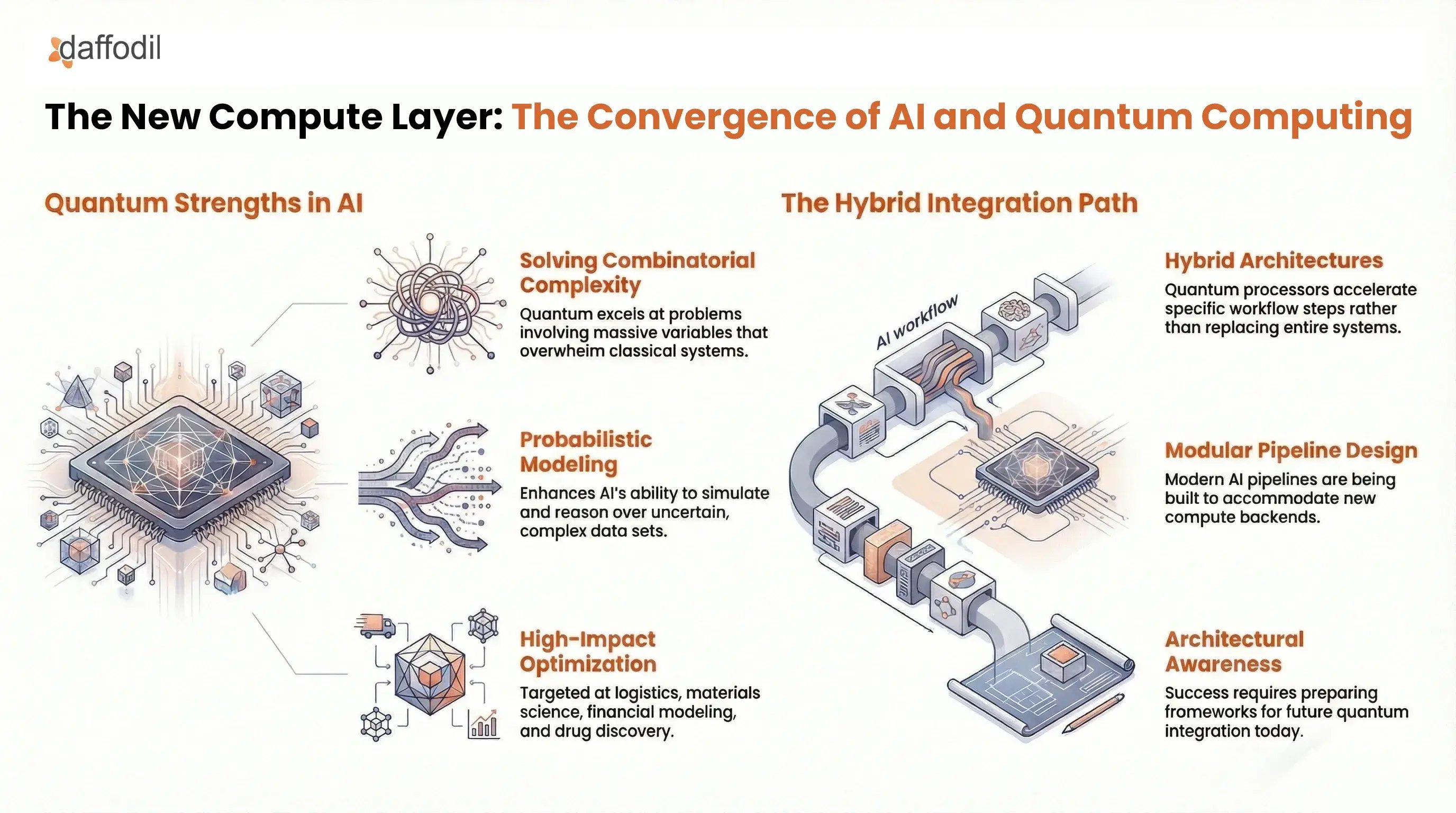
Rather than running AI models directly on quantum hardware, early integrations focus on hybrid architectures, where quantum processors are used to accelerate specific steps within a broader AI workflow.
For technology leaders, the takeaway is not immediate adoption, but architectural awareness. Teams designing AI systems today are beginning to consider how modular pipelines, abstraction layers, and orchestration frameworks could accommodate new compute backends.
What This Means When Choosing a Software Partner
In 2026, the question is no longer whether a partner can build an AI prototype. It’s whether they can help organizations run AI as a product.
- Strong partners demonstrate:
- Clear delivery metrics tied to business outcomes
- Proven paths from pilot to production
- Operational practices for monitoring, governance, and iteration
What makes 2026 a true inflection point is not a single breakthrough model or algorithm. It’s the fact that there are multiple forces: maturing AI capabilities, rising expectations for reliability, increasing regulatory pressure, and a growing realization that competitive advantage now depends on how well AI is woven into the thread of the business. This requires an understanding of AI not just as a capability, but as a long-term engineering discipline, one that spans architecture, governance, and continuous delivery.
For leaders navigating the top AI trends in 2026, execution maturity will be the true differentiator. If you’d like to discuss how these trends translate into real-world architecture and delivery, you can schedule a free consultation to explore what an AI-ready approach could look like for your company.