



.webp?width=750&height=321&name=AI%20for%20UI%20Design%20Automation%20(1).webp)
AI for UI design automation is reshaping how product teams design, validate, and ship interfaces, compressing timelines, reducing rework, and accelerating time-to-market at scale. Read more to understand how AI-driven UI design automation can help your teams ship faster.
Table Of Contents
1. Introduction: The Race Against Time in Product UI Design
2. Understanding AI’s Role in Modern UI Design Automation
3. Strategic Applications: How AI Accelerates Design Workflows
4. Team Strategies for Successful AI Implementation in Design
5. Measuring the Impact: Quantifying ROI in Design Automation
6. The Road Ahead: Challenges and Future Trends in AI Design Automation
7. Wrapping Up
Introduction: The Race Against Time in Product UI Design
Product UI design has become one of the biggest factors in how fast or how slow a product reaches the market. As digital experiences take centre stage across industries, UI design is no longer just a visual exercise. It sits at the intersection of user expectations, engineering feasibility, and business timelines.
Yet many product teams still treat UI design as a linear phase: design first, build later, fix issues at the end. But today, that approach is increasingly untenable. Markets move faster than roadmaps. Customer expectations evolve faster than release cycles. And every delay in translating UI intent into working software increases downstream costs.
This is where AI for UI design automation is beginning to shift the equation. Not by replacing designers, but by reshaping how UI workflows from idea to production, compressing timelines that once stretched into months.
The Criticality of Time-to-Market (TTM) in Competitive Landscapes
Time-to-market has moved beyond being an operational metric. For product leaders, it has become a strategic lever. Launching earlier means learning about user behavior, feature adoption, and market fit earlier. Teams that shorten TTM don’t just ship faster; they gain feedback loops their slower competitors never see. In contrast, delayed launches often come in a market that has already moved on, with user expectations shaped by someone else’s product.
UI design plays a disproportionate role in this dynamic. While engineering bottlenecks are visible and well-instrumented, UI-related delays often hide in plain sight: prolonged reviews, unclear specifications, late-stage usability fixes, and repeated handoffs between design and development. Individually, these issues seem minor. Collectively, they can add months to delivery timelines. Reducing time-to-market, then, isn’t only about faster coding. It requires rethinking how UI design decisions are created, validated, and implemented across the product lifecycle.
Traditional Bottlenecks Slowing Down the UI Design Process
Despite modern design tools, many UI workflows remain fundamentally manual. Research insights are synthesized by hand. Design variations are created one screen at a time. Feedback is scattered across tools, comments, and meetings. Handoffs rely on documentation that quickly goes out of sync with reality.
The most persistent bottlenecks tend to appear in four areas:
- Early-stage exploration, where teams limit options to save time, only to revisit decisions later
- Design consistency, where enforcing standards becomes a manual policing effort
- Handoffs to development, where ambiguity leads to clarifications, rewrites, and rework
- Late-stage validation, where accessibility issues are discovered too late
What makes these bottlenecks especially costly is not just the time they consume, but when they occur. Issues found late in the UI lifecycle are exponentially more expensive to fix, often triggering cascading changes across code, tests, and documentation.
AI as the Catalyst for UI Design Transformation
AI enters UI Design not as a shortcut, but as a structural change. Traditional automation follows rules. AI-driven systems learn patterns. That distinction matters. In UI design, where context, constraints, and trade-offs constantly shift, rigid automation quickly reaches its limits. Learning-based systems, on the other hand, can adapt to evolving design systems, user feedback, and historical project data.
Rather than accelerating isolated tasks, AI enables continuous design intelligence, supporting decisions as they are made, not after problems emerge. The result is fewer late surprises, smoother handoffs, and faster adoption from concept to production-ready UI.
This is why AI is increasingly viewed as a catalyst for design transformation, not just productivity gains.
Understanding AI’s Role in Modern UI Design Automation
UI design automation powered by AI is not about speeding up isolated tasks; it’s about reshaping the flow of work across design, development, and delivery. In high-performing product organizations, AI is increasingly embedded directly into workflows, producing insights and interventions at the moment decisions are made.
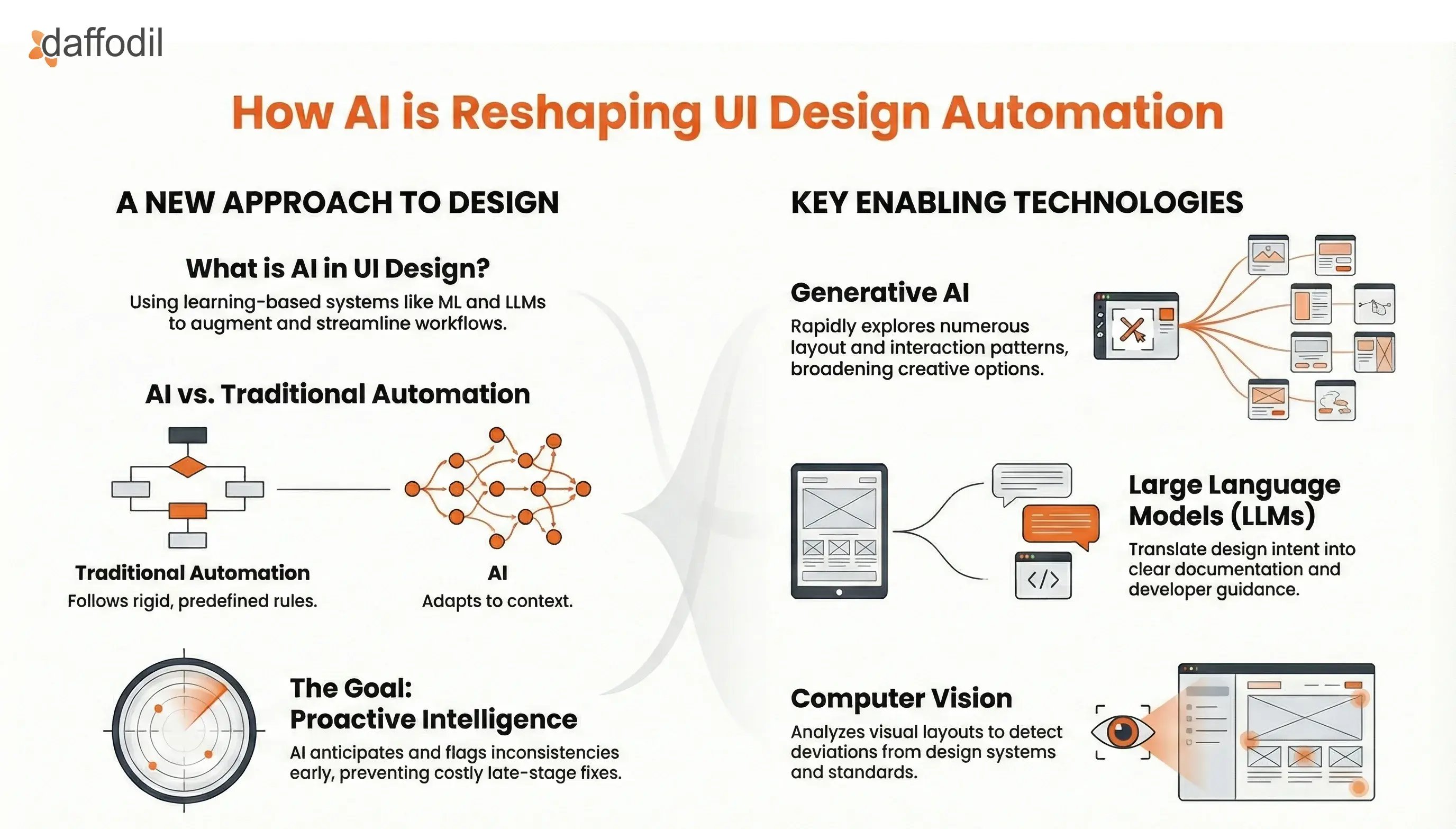
Instead of reacting to problems after designs are finalized, AI-driven systems help teams anticipate friction early, flagging inconsistencies, predicting downstream complexity, and keeping design intent aligned with implementation. This shift from reactive correction to proactive design intelligence is what makes AI relevant at scale. For organizations under pressure to ship faster without sacrificing quality, AI for UI design automation becomes a structural advantage rather than a productivity hack.
Read also: Context-Based UI: Enhancing User Experience Through Contextual Design.
Defining AI for UI Design Automation
AI for UI design automation refers to the use of learning-based systems, such as machine learning models, language models, and pattern-recognition algorithms, to augment and streamline UI design workflows.
Unlike traditional automation, which executes predefined rules, AI-driven automation adapts to context. It learns from historical design systems, user feedback, and implementation outcomes to improve how UI decisions are created, validated, and handed off.
In practice, this means:
- Fewer manual checks for consistency and compliance
- Faster translation of design intent into build-ready artifacts
- Continuous alignment between UX/UI design services and engineering constraints
Designers remain responsible for judgment, creativity, and user empathy. AI absorbs the repetition, validation, and coordination work that traditionally slows teams down.
Key AI Technologies Transforming Design Workflows
Several AI technologies are converging to make UI design automation viable in real-world product environments:
- Generative AI enables rapid exploration of layout and interaction patterns, allowing teams to evaluate more options early without linear effort.
- Large language models (LLMs) translate UI intent into structured outputs: design, documentation, component definitions, and developer guidance, reducing ambiguity at handoff.
- Computer vision systems analyze visual layouts to detect deviations from design systems, accessibility standards, or brand rules.
Together, these technologies move UI design from static to adaptive systems that evolve with the product.
Strategic Applications: How AI Accelerates Design Workflows
AI for UI design automation delivers the most value when applied across the full design lifecycle, not just at the beginning or the end.
Streamlining Concept Generation and Exploration with Generative Design
Early-stage design is often constrained by time, not imagination. Teams narrow options prematurely to stay on schedule, increasing the risk of rework later. Generative design systems invert this dynamic. By rapidly producing multiple layouts and interaction variations based on constraints, AI allows designers to explore broader solution spaces in less time.
Large consumer technology companies are applying generative AI to explore user interface variations before committing engineering effort. For example, Google’s Generative UI research shows that systems automatically create rich interactive user interfaces in response to prompts. The research indicates that interfaces generated by these models are strongly preferred by human raters over standard outputs. This highlights the viability of automated UI generation as part of modern design workflows.
In the retail sector, companies like Walmart are building AI-driven adaptive experiences that tailor digital interactions to individual users without requiring designers to rebuild interfaces from scratch. This ensures consistent experiences without requiring designers to rebuild from scratch. The result is not faster creativity, but more informed creativity earlier, when change is cheapest.
Accelerating Drafting and CAD Processes with AI
While UI design is often associated with screens and flows, drafting remains a critical bottleneck, especially in complex digital products that rely on detailed component libraries and interaction specifications.
AI-assisted drafting automates repetitive layout work, enforces design-system rules, and flags inconsistencies in real time. This mirrors what has already happened in CAD-heavy industries, where AI automation has reduced drafting cycles dramatically by catching errors before review.
For UI teams, the impact is similar: designers spend less time enforcing standards manually and more time refining user experience and intent.
Intelligent Prototyping and Simulation for Faster Iterations
Prototyping traditionally sits in an uncomfortable middle ground, too slow to be disposable, too rough to be definitive. AI-enhanced prototyping changes that balance. By simulating user interactions, performance constraints, and accessibility outcomes, AI allows teams to validate assumptions before designs are finalized.
E-commerce platforms increasingly rely on AI-driven simulations to predict how changes in navigation will impact user behavior. For example, Shopify uses machine learning and predictive analytics to identify checkout drop-off points and optimize conversion pathways. This helps teams anticipate user behavior and adjust interface elements before extensive engineering work is done.
These intelligent feedback loops allow product teams to validate hypotheses about user behavior early. This often happens before formal usability testing, reducing the friction between design intent and user realities.
AI-Enhanced UI Design Reviews and Feedback Integration
Design reviews often become bottlenecks because feedback arrives fragmented, subjective, and late. AI systems help standardize and accelerate this process by:
- Automatically checking accessibility and usability rules
- Highlighting deviations from established patterns
- Aggregating feedback across tools into coherent signals
This doesn’t eliminate human review; it sharpens it. Review conversations move from surface-level issues to high-level decisions, quickening decision-making rather than prolonging debate.
Automating Documentation, Compliance, and Naming Conventions
One of the least visible, but most time-consuming parts of UI design is documentation. AI-driven automation generates and maintains design specs, naming conventions, and compliance artifacts continuously as designs evolve. This reduces the gap between design and implementation and minimizes clarification cycles with engineering.
For regulated industries such as healthcare or finance, automated compliance checks embedded in the design workflow can reduce risk without slowing delivery. According to the Wall Street Journal, UnitedHealth Group has deployed 1,000 AI applications across its business, reducing administrative burdens and improving workflows.
Similarly, JPMorgan Chase has shared how its developers leverage AI to automatically generate pull request descriptions, documentation, and change summaries.
Team Strategies for Successful AI Implementation in Design
Technology alone does not create speed; teams do. Organizations that succeed with AI for UI design automation treat it as an organizational capability, not a standalone tool.
Integrating AI into Agile & DevOps Methodologies
AI delivers the most value when integrated into existing Agile and DevOps workflows rather than layered on top. Leading product teams use AI to:
- Produce design risks during sprint planning
- Reduce feedback latency between design and development
- Validate UI changes continuously with code
This tight integration shortens iteration loops and keeps UI quality aligned with delivery speed.
Building a Robust Data Foundation for AI in Design
AI systems are only as effective as the data they learn from. High-performing teams invest early in:
- Structured design systems
- Historical UI components
- Clear feedback loops between design outcomes and user behavior
This foundation allows AI to learn patterns that reflect real-world usage rather than theoretical best practices.
Selecting and Scaling the Right AI Tools and Platforms
Most organizations don’t fail at AI adoption; they stall. Successful teams follow a consistent pattern:
- Start with high-friction UI workflows
- Prove measurable impact on time-to-market
- Scale deliberately across teams and products
Within this approach, several AI-enabled design platforms are emerging as practical enablers of UI design automation:
- Uizard focuses on rapid ideation, using AI to convert hand-drawn sketches into editable UI designs and interactive prototypes.
- Adobe Firefly brings generative AI into Adobe’s Creative Cloud, allowing teams to automate asset creation, typography variations, and visual consistency at scale.
- Google Stitch represents a newer class of generative UI tooling, translating prompts and sketches into styled interface visuals with exportable frontend code.
- Figma AI embeds generative capabilities directly into the design environment. This helps teams generate UI layouts, rename layers, populate content, and create prototypes from prompts.
Rather than chasing novelty, companies prioritize tools that integrate cleanly into existing ecosystems and support governance. For many organizations, this is where experienced software partners, such as Daffodil Software, help teams move from experimentation to intelligent automation.
.webp?width=2752&height=1613&name=Info_5%20(1).webp)
Measuring the Impact: Quantifying ROI in Design Automation
As AI for UI design automation moves from experimentation to adoption, quantifying its impact becomes important. ROI in this context isn’t just about time saved. It’s about speed at every stage of product delivery, measurable quality improvements, and strategic reallocation of human effort.
The organizations seeing payoff are those that measure outcomes not in abstract efficiency percentages but in concrete business results: shorter release cycles, higher team output, reduced error rates, and faster feedback loops from users to product teams.
Across industries, leading teams are treating AI as a productivity layer that generates insights and produces measurable outcomes.
Direct Reduction in Time-to-Market
A direct benefit organizations report from AI-enabled design automation is shorter design lifecycles, translating to faster overall releases. McKinsey reports that teams applying generative AI across product development workflows have achieved around a 5% acceleration in product time-to-market. Additionally, Intuit has reshaped its AI strategy to eliminate manual work and accelerate internal product workflows, moving toward agentic AI that reduces friction in feature development and prototyping cycles.
Enhanced Efficiency and Productivity Gains
Productivity gains tied to AI-driven design workflows extend beyond speed. They impact how teams allocate cognitive effort, shifting human focus from repetitive enforcement of standards toward problem solving and innovation.
Companies embracing this shift report measurable increases in throughput:
- Slack’s Workforce Index shows that AI adoption among knowledge workers has increased, with daily AI use over 230% higher than six months earlier and daily users reporting 64% higher productivity and 58% better focus.
- At companies like Zillow, machine learning and AI power more personalized and adaptive user experiences, from interpreting behavioral signals to shaping continuity across devices.
Research applying large language models to UI mockups also shows that AI-generated feedback can catch subtle design issues and improve interface quality compared with manual evaluation alone.
Cost Savings and Optimized Resource Allocation
AI for UI design automation also influences how companies deploy budgeted talent and technical resources. Automating repetitive tasks reduces reliance on contractor time for drafting, documentation, and compliance tagging, resulting in tangible cost savings.
In financial services, organizations like Capital One have publicly described how AI is embedded across engineering and product workflows to reduce manual effort and operational friction. In regulated healthcare environments, organizations such as Kaiser Permanente have adopted AI-driven automation to streamline review-heavy workflows. They have shared how AI and advanced analytics help reduce operational blockers across digital systems.
Driving Innovation and Superior Product Quality
Faster time-to-market and higher productivity are necessary, but not sufficient conditions for long-term success. What separates leading adopters is the consistency and quality of user experience delivered across releases.
AI-assisted design systems also play a critical role in maintaining product quality at scale. Netflix has shared how machine learning supports consistent user experiences across devices by powering experimentation, personalization, and shared UI component systems.
This consistency, combined with faster release cycles, enables teams to invest more time in experimenting with novel interactions, improving overall product satisfaction.
The Road Ahead: Challenges and Future Trends in AI Design Automation
While the potential upside of AI for UI design automation is compelling, the landscape ahead is neither uniform nor trivial. Success depends on navigating several key challenges and aligning technology with human practice.
Addressing Challenges: Data Privacy, Ethics, and Human Oversight
Automated systems generate and consume data at a scale that deepens ethical and privacy concerns. For example, automated UI simulations that leverage user interaction data must be designed with robust privacy controls.
Moreover, biases embedded in historical design decisions can get amplified in machine learning workflows unless teams enforce human oversight and ethical guardrails. Leading organizations such as Salesforce and Microsoft have developed internal frameworks for responsible AI that explicitly govern how automated design suggestions are produced and reviewed. These guardrails ensure AI remains a collaborator, not a dictator of design decisions.
Evolving AI Capabilities and Emerging Trends
AI adoption in design has followed the broader automation arc: rule-based aids, pattern recognition, and then generative synthesis. Today, we are entering an era where context-aware design intelligence becomes mainstream, synthesizing complex constraints like accessibility, performance budgets, and device fragmentation in real time.
Emerging trends include:
- AI-driven design token standardization
- Seamless design-to-code translation
- Contextual natural language design assistants
US product teams at companies like Dropbox and Shopify are already experimenting with integrated design assistants that offer real-time suggestions grounded in product intent, not just templates.
The Future of Human–AI Collaboration in Design
By 2026, AI for UI design automation will move well beyond assistive tooling to embedded design intelligence. These systems understand not just how interfaces look, but how they perform across business, technical, and human dimensions. Rather than reacting to prompts, AI systems will increasingly operate as context-aware collaborators, continuously learning from product telemetry, user behavior, and team feedback loops.
By 2026, leading product organizations are expected to see:
- Design copilots trained on proprietary design systems, capable of suggesting UI patterns that align with brand, accessibility standards, and engineering constraints.
- Near-real-time design-to-code translation, where validated UI decisions convert into components with minimal manual intervention.
- Predictive design risk alerts flag potential usability, accessibility, or performance issues before designs enter development.
- Shared design intelligence across teams, allowing design, engineering, and QA to operate from an updated system of record rather than static data.
By 2026, the most successful teams won’t be those with the most AI tools, but those that have learned how to collaborate with AI as a first-class design partner, not just a productivity layer.
.webp?width=2752&height=1536&name=Info_6%20(1).webp)
Wrapping Up
AI for UI design automation is not a trend; it is a structural shift in how digital products are conceived, validated, and delivered.
Organizations that strategically embed AI into their design workflows find that they are not only faster, but they are also learning more quickly. They reduce friction at handoff points, strengthen consistency across products, and empower human creativity where it matters most.
Recap of AI’s Power in UI Design Automation
- AI for UI design automation accelerates release cycles without sacrificing quality.
- Productivity gains result in human effort going to higher-value design work.
- Cost decreases when compliance and documentation are automated.
- Innovation accelerates as teams iterate with confidence.
These are not abstract outcomes; they are measurable outcomes seen in US companies leading the economy today.
If your team is struggling with slow UI workflows, repeated rework, or fractured collaboration between design and engineering, now is the time to act. Explore how we can help organizations adopt AI for UI design automation strategically, with integration, governance, and scale in mind.
- Start with a design automation strategy audit.
- Identify high-impact workflows ripe for AI support.
- Build a roadmap that aligns design intelligence with delivery velocity.
The future of product design isn’t just faster. It’s smarter, more consistent, and more human-centric, powered by AI and guided by team intelligence.