
.webp?width=750&height=321&name=Agentic%20AI%20for%20Fraud%20Detection%20(1).webp)
Agentic AI is changing how fraud is detected. Learn what it is, why it matters, and how banks, payments, and e-commerce teams are already using it in real-world systems.
The financial ecosystem is facing an unprecedented fraud crisis. In 2024 alone, consumer fraud losses reached $12.5 billion, marking a 25% year-over-year increase, according to the U.S. Federal Trade Commission. As fraudsters adopt advanced techniques such as deepfakes, synthetic identities, and AI-driven social engineering, traditional rule-based detection systems are struggling to keep pace.
The global picture is even more concerning, with fraud losses far exceeding regional figures.
At the same time, AI is changing how financial institutions fight back. An AllAboutAI analysis shows that AI-powered fraud detection systems successfully prevented more than $25.5 billion in attempted fraud, demonstrating their growing effectiveness in real-world financial environments. With detection accuracy reaching up to 98%, AI is no longer an experimental layer, it is becoming a foundational component of modern fraud prevention architectures.
The business impact is equally compelling. According to the Alloy fraud report 2025, 87% of financial institutions using AI-driven fraud detection report that the savings outweigh the cost of implementation. These systems don’t just detect anomalies; they continuously learn, adapt to new attack patterns, and act in real time—something static, manual approaches simply cannot achieve.
The conversation has shifted. The question is no longer whether AI can combat financial fraud, but how quickly organizations can operationalize AI-driven defenses before the next wave of sophisticated attacks emerges.
This article examines what agentic AI is, its significance for fraud detection, its practical application, and how forward-looking organizations are already leveraging it across banking, payments, e-commerce, and digital platforms.
The Growing Complexity of Fraud in the AI Era
Fraud tactics have evolved dramatically over the past decade. Today’s fraudsters leverage automation, synthetic identities, deepfakes, and social engineering at scale. Attacks are faster, more coordinated, and increasingly multi-channel, spanning transactions, accounts, devices, and even voice interactions.
According to a recent study, Financial crime is becoming more interconnected and dynamic, making siloed detection systems ineffective. Fraud now unfolds across journeys rather than single events, requiring systems that can adapt continuously and respond in real time.
Beyond external attacks, organizations are increasingly exposed to corporate fraud risk, ranging from insider trading and expense manipulation to procurement fraud and financial statement abuse. Unlike transactional fraud, these risks unfold over extended timelines, involve trusted employees or partners, and span multiple internal systems such as finance, procurement, and access controls. Their gradual, low-signal nature allows them to bypass rule-based and event-driven detection models that are optimized for high-velocity consumer fraud, making corporate fraud both harder to detect and more costly when left unchecked.
This complexity exposes the limitations of traditional fraud detection approaches:
Static rules generate high false positives
-
Supervised ML models struggle with novel fraud patterns
-
Manual reviews slow down response times
-
Fragmented tools prevent holistic risk assessment
To counter adaptive adversaries, organizations need adaptive defenders. This is where agentic AI for fraud detection enters the picture. But the challenge is no longer a lack of data or detection techniques. It is an architectural mismatch between how modern fraud operates, continuously, across systems, and at machine speed, and how most fraud platforms are designed to respond.
How Is Agentic AI Different From Generative AI in Fraud Risk Detection?
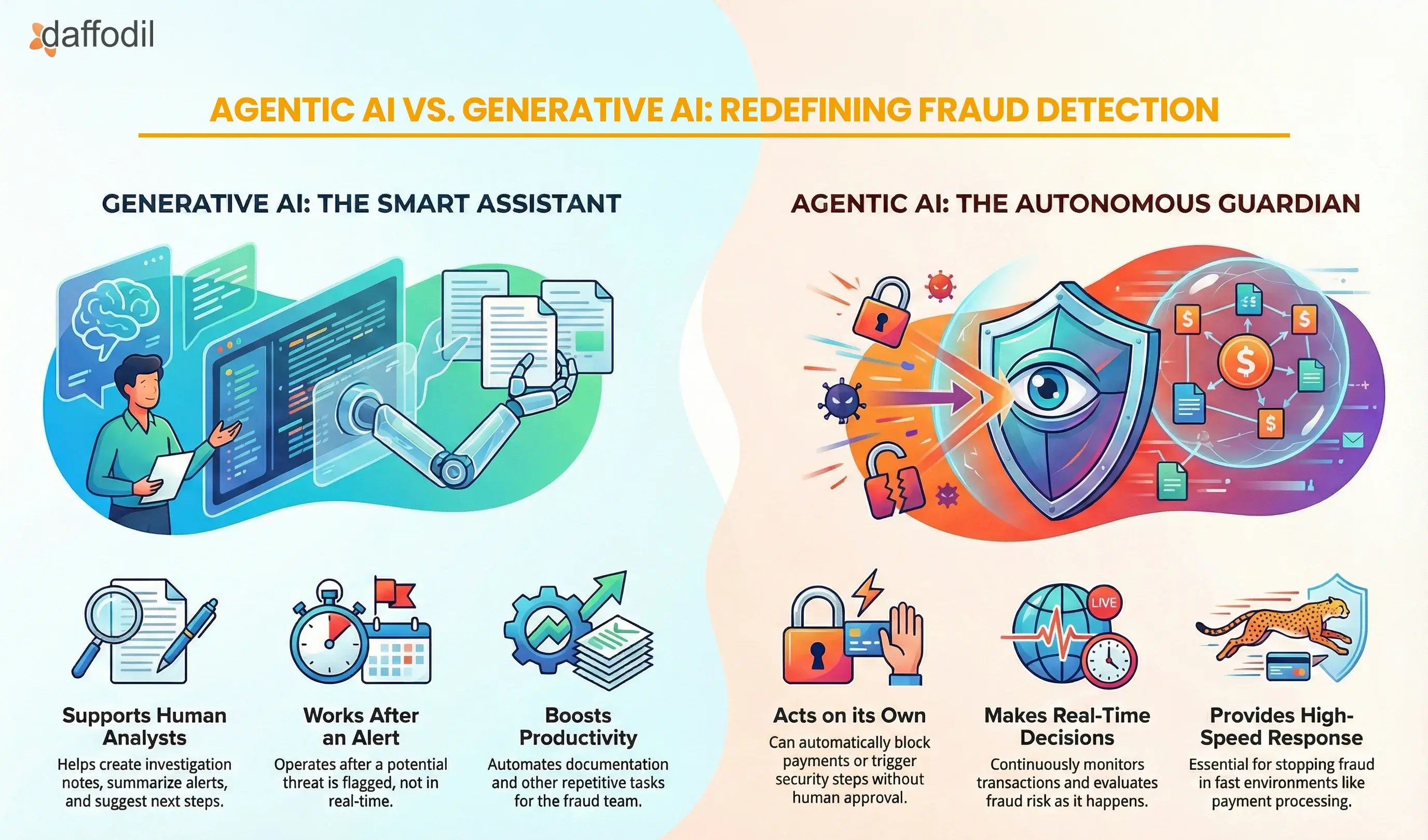
Generative AI and agentic AI play fundamentally different roles in fraud risk management. While both rely on advanced machine learning, only agentic AI is designed to take autonomous action in live fraud environments.
Generative AI: Enhancing Fraud Investigation and Reporting
Generative AI plays a supportive role in fraud detection but does not act autonomously. Its primary function is to assist human analysts in content creation and decision-making tasks. Here's how it contributes to fraud risk management:
-
Content Generation: Automates the creation of investigation notes, summarization of alerts, and model output explanations.
-
Analyst Assistance: Helps analysts by providing insights, generating reports, and suggesting next steps in fraud investigations.
-
Workflow Automation: Improves productivity by assisting in documentation and reducing the time spent on repetitive tasks.
-
Asynchronous Operation: Works after an alert is raised or a case is created, focusing on providing information rather than real-time decisions.
While generative AI boosts productivity and enhances human decision-making, it does not take autonomous actions or influence operational systems.
Agentic AI: Autonomous Fraud Detection and Response
In contrast, Agentic AI is designed to take real-time, autonomous actions using predictive analysis to detect and stop fraud. It represents a shift from AI as a tool to AI as an active agent capable of making decisions and executing tasks. Here’s how Agentic AI works in fraud risk management:
-
Continuous Monitoring: Actively monitors transactions, correlates signals, and evaluates fraud risk in real time.
-
Autonomous Actions: Takes action without human intervention, such as blocking payments, triggering authentication steps, or escalating suspicious cases.
-
Real-Time Decision Making: Combines predictive analysis with immediate decision-making, enabling rapid responses to fraud.
-
High-Speed Response: Ideal for high-velocity environments like payment flows or account takeovers, where milliseconds matter to prevent financial loss.
Agentic AI is designed to handle end-to-end fraud management tasks within set guidelines, providing scalable, autonomous protection against fraud.
At this point, the distinction becomes clear. The limitations facing fraud teams are not rooted in model accuracy alone, but in how decisions are made, actions are executed, and learning is applied across the fraud lifecycle. Addressing this gap requires more than better detection; it requires a fundamentally different operating model.
Why Agentic AI Is a Breakthrough for Fraud Detection?
Agentic AI is not a new detection technique. It is a new fraud operating model. Instead of treating fraud prevention as a sequence of disconnected alerts and manual decisions, agentic systems embed intelligence directly into the flow of transactions, identities, and investigations.
1. From Detection to Decision-Making
Traditional AI flags suspicious activity. Agentic AI decides what to do next.
An agentic fraud system can:
-
Detect anomalous behavior
-
Cross-check identity, device, and behavioral signals
-
Decide whether to block, challenge, allow, or escalate
-
Trigger downstream workflows automatically
This shift dramatically reduces response time while improving accuracy.
2. Continuous Learning in Real Time
Fraud patterns change daily. Agentic systems are designed to learn continuously, not periodically.
Agentic systems use feedback loops and reinforcement learning, allowing fraud agents to refine strategies based on outcomes, such as confirmed fraud, customer friction, or investigator feedback.
This makes AI agents for detecting financial fraud far more resilient against zero-day attacks and emerging fraud typologies.
3. Multi-Agent Collaboration Across the Fraud Lifecycle
A defining feature of agentic AI is multi-agent orchestration.
In a fraud context, this may include:
-
A transaction monitoring agent
-
A behavioral analysis agent
-
A device fingerprinting agent
-
An identity verification agent
-
A case management agent
Each agent specializes in a task but shares context with others. Together, they create a unified fraud intelligence layer.
How Agentic AI for Fraud Detection Works?
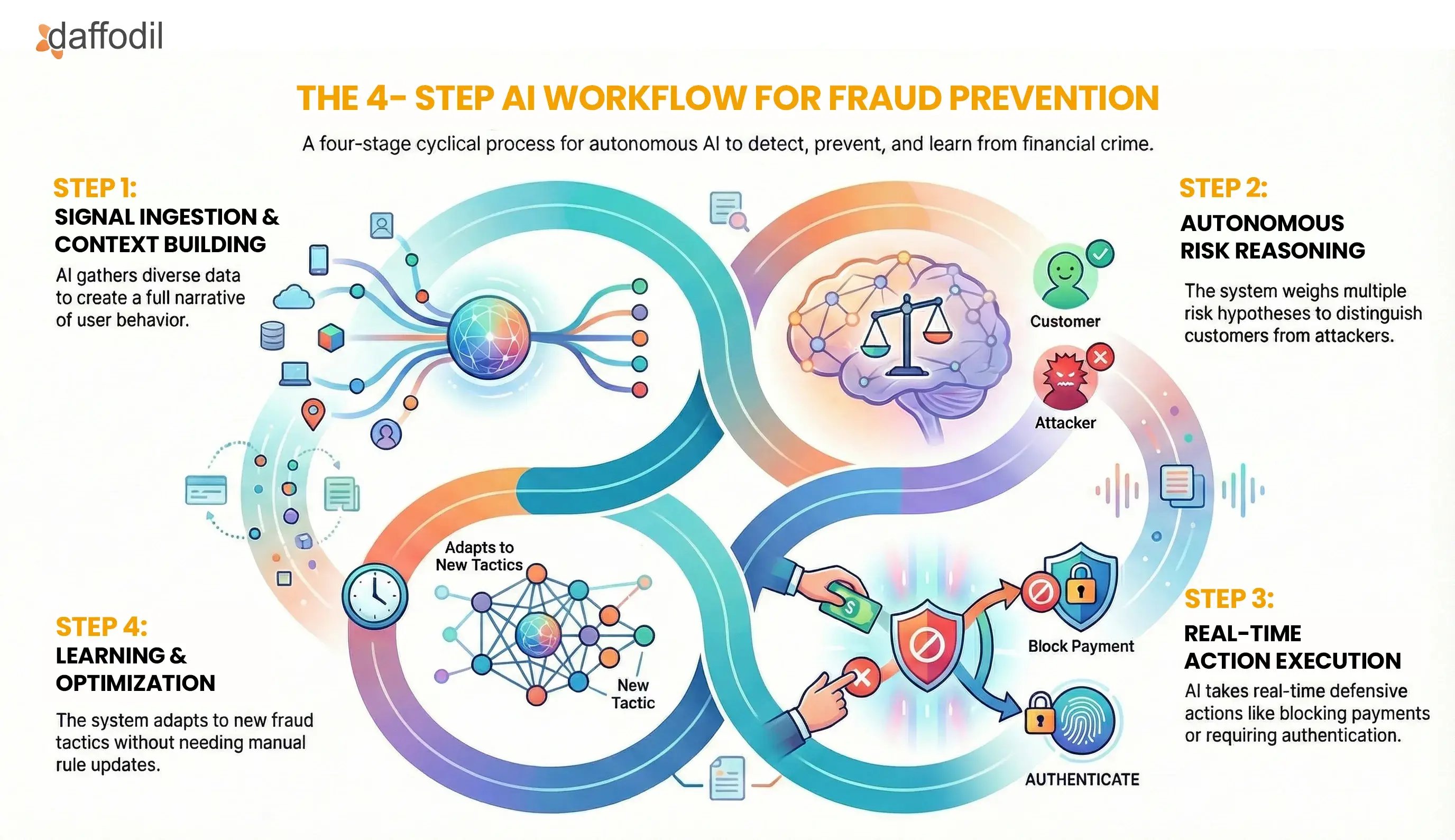
Step 1: Signal Ingestion and Context Building
AI agents collect and contextualize data from multiple sources, creating a comprehensive view of risk:
-
Transactions: Monitor payments across channels in real time.
-
User Behavior: Track login patterns, device usage, and interaction sequences.
-
Devices and Networks: Analyze device fingerprints, IP addresses, and network anomalies.
-
Historical Fraud Patterns: Leverage past fraud cases to anticipate future attacks.
External Threat Intelligence: Incorporate insights from threat feeds, dark web monitoring, and industry consortia.
Platforms like Featurespace ARIC Risk Hub, Fraugster, and SAS Fraud Management support advanced signal ingestion and real-time contextual analysis, helping detect subtle fraud patterns early.
Instead of evaluating each signal independently, agentic systems build contextual risk narratives, allowing them to understand whether a pattern is suspicious within the broader transaction context.
Step 2: Autonomous Risk Reasoning
AI agents don’t just score risk, they reason across multiple hypotheses simultaneously:
-
Is this user behaving like themselves?
-
Does this transaction match historical intent?
-
Are multiple accounts or devices coordinating suspicious activity?
This reasoning layer reduces false positives and ensures legitimate customers aren’t unnecessarily blocked.
Solutions like Kount AI, Shift Technology, and DataVisor provide AI-driven reasoning engines that can detect complex fraud patterns, including coordinated attacks and synthetic identities.
Step 3: Action Execution
Based on the reasoning outcomes, agentic AI systems autonomously act to mitigate risk in real time:
-
Block or allow transactions instantly.
-
Trigger step-up authentication for high-risk actions.
-
Route suspicious cases to human investigators for review.
-
Initiate recovery workflows in the event of fraud.
Platforms such as FraudShield, Feedzai, Forter, and Featurespace can automatically enforce risk decisions at the point of interaction, enabling real-time prevention rather than post-fraud remediation.
Step 4: Learning and Optimization
Agentic AI continuously improves its effectiveness by feeding outcomes back into the system:
-
Was fraud confirmed?
-
Did the customer abandon the transaction?
-
Was the alert accurate and actionable?
Agents adapt strategies without manual rule updates, using reinforcement learning to detect new fraud tactics more efficiently over time.
AI frameworks like H2O.ai, FeatureSpace Adaptive Behavioral Analytics, and Shift Technology’s AI support self-learning loops, helping the system evolve alongside emerging threats.
Key Use Cases of Agentic AI for Fraud Detection
Agentic AI is most effective when deployed across high-velocity, high-risk fraud surfaces where speed, context, and autonomous action matter. By coordinating multiple AI agents for fraud detection, organizations can identify threats earlier, respond faster, and reduce downstream losses across industries.
Banking and Financial Services
Banks face some of the most complex fraud scenarios due to real-time payments, regulatory scrutiny, and sophisticated attack networks. Agentic AI for fraud detection enables continuous, autonomous monitoring across accounts, channels, and transactions.
Key use cases of fraud prevention include:
-
Real-time transaction fraud prevention, where AI agents assess risk during payment authorization and intervene before funds move
-
Account takeover detection, using behavioral drift, device changes, and access anomalies to stop credential-based attacks
-
Mule account identification, where network-level agents detect coordinated money movement patterns across multiple accounts
By acting autonomously within defined guardrails, agents reduce reliance on manual reviews while maintaining auditability and compliance.
Also read: AI in accounting software: tools, use cases, and LLM models
Fraud Prevention in Payments and Fintech
Payments and fintech platforms operate at high scale with limited tolerance for latency or false positives. Here, AI agents for detecting financial fraud continuously adapt to new attack patterns without disrupting legitimate transactions.
Common fraud prevention applications include:
- Card-not-present fraud detection, combining transaction context, device signals, and behavioral data in real time
- Friendly fraud identification, where agents distinguish legitimate chargebacks from intentional misuse
- Cross-border transaction monitoring, detecting abnormal routing, velocity spikes, and jurisdictional risk shifts
Agentic systems learn from outcomes, enabling faster adaptation to emerging fraud tactics common in global payment flows.
Fraud Prevention in E-Commerce and Marketplaces
E-commerce and digital marketplaces face persistent threats from automated attacks and abuse-driven fraud. Agentic AI for fraud detection allows platforms to respond dynamically to both human and bot-driven activity.
Key use cases of fraud prevention include:
-
Fake account creation prevention, using identity, behavioral, and network intelligence to block fraudulent onboarding
-
Promotion and incentive abuse detection, where agents monitor usage patterns across accounts and campaigns
-
Bot-driven fraud mitigation, identifying automated behavior that bypasses traditional rule-based defenses
By coordinating detection and response across user journeys, agentic AI helps marketplaces protect revenue while preserving a frictionless customer experience.
Governance, Explainability, and Trust
Agentic AI will require access to a wide array of internal systems — from transaction history and customer data to authentication and communication logs. Without strict governance, this level of access introduces substantial privacy and compliance risk.
When it comes to autonomous AI, the first question on everyone’s mind is often: who’s really in control? In highly regulated industries like banking and financial services, this question is critical. Organizations must ensure that AI-driven decisions are transparent, accountable, and compliant with evolving regulations, including frameworks like the EU Data Act, which emphasizes data governance, traceability, and responsible AI use.
Modern agentic AI for fraud detection is specifically designed to address these concerns. These systems operate with clear guardrails, ensuring every action can be understood, reviewed, and trusted by human teams. This combination of autonomy and oversight allows organizations to harness the speed and adaptability of AI without sacrificing control or compliance.
Key ways this trust is achieved include:
-
Human oversight where it matters – allowing fraud teams to intervene in complex or high-risk cases
-
Clear, explainable decisions – showing what signals were evaluated and why an action was taken
-
Policy-constrained autonomy – letting AI act independently only within pre-approved rules and risk thresholds
-
Auditable action trails – providing a full record for review, compliance, and model improvement
When done right, AI agents for fraud detection don’t replace human judgment; they extend it, handling routine decisions at machine speed while keeping teams fully in control. This balance makes agentic AI both effective and trustworthy, even in highly regulated environments.
How Can Organizations Implement Agentic AI for Fraud Detection?
Step 1: Identify High-Impact Fraud Journeys
Start by pinpointing fraud scenarios where speed, autonomy, and context matter most, such as real-time payments, account access, or onboarding.
-
Focus on journeys with high fraud losses or false positives
-
Prioritize flows where delayed decisions cause financial or customer impact
-
Avoid starting with low-risk or low-volume use cases
Step 2: Build a Unified Signal Foundation
Agentic AI depends on rich, connected signals. Consolidate transaction data, user behavior, device intelligence, and historical fraud outcomes into a shared context layer.
-
Ensure data quality and consistency across systems
-
Design for real-time ingestion, not batch processing
-
Maintain strict data governance and access controls
Step 3: Design Clear Agent Objectives and Boundaries
Define what each AI agent is allowed to do, when it should act autonomously, and when it must escalate to humans.
-
Set explicit goals (e.g., prevent fraud vs reduce friction)
-
Establish risk thresholds and action limits
- Align agent behavior with compliance and internal policies
Step 4: Implement Autonomous Reasoning and Decision Logic
Move beyond single risk scores. Enable agents to reason across multiple hypotheses, behavioral consistency, transaction intent, and network-level coordination.
-
Prioritize explainable reasoning over black-box decisions
-
Balance fraud prevention with customer experience
-
Continuously test for bias and unintended outcomes
Step 5: Enable Real-Time Action Execution
Integrate agents directly into transaction and authentication flows so they can act at the moment of risk.
-
Ensure low-latency system integration
-
Define safe fallback actions in case of uncertainty
-
Avoid over-blocking legitimate users
Step 6: Embed Governance and Explainability by Design
Trust is critical. Every agent action must be traceable, explainable, and auditable, especially in regulated environments.
-
Maintain detailed decision logs and action trails
-
Enable human-in-the-loop review for high-risk cases
-
Align with regulatory frameworks such as the EU Data Act
Step 7: Establish Continuous Learning Loops
Feed outcomes back into the system so agents can adapt to new fraud patterns without manual rule updates.
-
Track outcomes like confirmed fraud, customer friction, and investigator feedback
-
Monitor agent performance over time
-
Prevent model drift through controlled learning policies
Step 8: Scale Gradually Across Channels
Once validated, expand agentic AI across additional fraud surfaces, payments, accounts, voice, and identity.
-
Reuse core agent logic across channels
-
Monitor cumulative system behavior, not just individual agents
-
Continuously reassess governance as autonomy increases
Final Thoughts
Agentic AI for fraud detection is not an incremental upgrade; it’s a fundamental shift in how fraud is prevented. By combining autonomy, contextual reasoning, agent collaboration, and continuous learning, agentic systems respond faster, adapt better, and remain resilient as fraud patterns evolve.
As financial crime becomes more sophisticated, organizations that adopt AI agents for detecting financial fraud are better equipped to protect customers, reduce losses, and maintain trust at scale. If you’re exploring how agentic AI could fit into your fraud detection architecture or want to assess where your current systems fall short, connect with our team. We’re happy to discuss your use cases, constraints, and next steps.