---
title: "LangGraph vs CrewAI vs AutoGPT: Best Multi-Agent Framework in 2026"
description: Compare LangGraph vs CrewAI vs AutoGPT to understand their key differences, strengths, use cases, and trade-offs, and find the right multi-agent framework
image: https://insights.daffodilsw.com/hubfs/Banner%20image_LangGraph%20vs%20CrewAI%20vs%20AutoGPT.webp
---
[](https://www.daffodilsw.com/)

[](https://www.daffodilsw.com/)
[](https://www.daffodilsw.com/)
- Services
- Consulting
- Design
- Software Development
- AI/ML Solutions
- Software Testing and QA
- Software Maintenance and Support
- Marketing
- Team Augmentation
[ Software Consulting End-to-end software consulting services for web, mobile, and cloud-based solutions](https://www.daffodilsw.com/software-consulting-services) [ Cloud Consulting Architect and optimize cloud-native solutions that enhance agility, resilience, and cost efficiency.](https://www.daffodilsw.com/cloud-consulting-services) [ Legacy System Modernization Modernize legacy systems into secure, scalable, and future-ready digital platforms.](https://www.daffodilsw.com/legacy-software-modernization-services) [ Security & Compliance Advisory Strengthen your technology landscape by embedding security and compliance into every layer.](https://www.daffodilsw.com/application-security-consulting) [ AI Strategy Consulting Unlock business value by defining and implementing a clear, results-driven AI roadmap.](https://www.daffodilsw.com/ai-consulting-services)
[ UI/UX Design Design intuitive, user-centric interfaces that elevate engagement and drive measurable outcomes.](https://www.daffodilsw.com/ui-ux-design-services) [ Discovery & MVP Planning Validate product ideas and define a focused MVP roadmap that accelerates time to market.](https://www.daffodilsw.com/product-discovery-services) [ Product Experience Design Craft seamless end-to-end product experiences that align user needs with business goals.](https://www.daffodilsw.com/experience-design-services)
[ Web Application Development Build scalable, high-performance web applications tailored to your unique business workflows.](https://www.daffodilsw.com/web-application-development-company) [ Mobile App Development Develop intuitive, feature-rich mobile apps that deliver seamless experiences across devices.](https://www.daffodilsw.com/mobile-app-development-company) [ SaaS & Platform Development Engineer robust, extensible platforms that support growth, integrations, and evolving business needs.](https://www.daffodilsw.com/digital-platform-development) [ API Development & Integrations Connect systems and streamline operations by designing secure, reliable APIs and integrations.](https://www.daffodilsw.com/custom-api-development-services) [ Cloud Services Enable agility and resilience by migrating, managing, and optimizing your cloud infrastructure.](https://www.daffodilsw.com/managed-cloud-services) [ Cloud-Native Applications Create resilient, scalable cloud-native applications built for performance and rapid innovation.](https://www.daffodilsw.com/services/cloud-native-development) [ DevOps Services Accelerate releases and improve reliability by implementing automated, scalable DevOps practices.](https://www.daffodilsw.com/devops-services)
[ Data & ML Engineering Design and operationalize scalable data pipelines and ML systems that power intelligent decision-making.](https://www.daffodilsw.com/data-engineering-services) [ GenAI & LLM Solutions Develop generative AI and LLM-powered applications that automate workflows and enhance human productivity.](https://www.daffodilsw.com/generative-ai-services-and-solutions) [ Conversational AI Solutions Create intelligent conversational systems that deliver natural, context-aware customer interactions.](https://www.daffodilsw.com/conversational-ai-solutions) [ Agentic AI Solutions Deploy autonomous AI agents that reason, plan, and execute complex tasks across systems.](https://www.daffodilsw.com/ai-agent-development-company) [ Computer Vision solutions Implement computer vision systems that extract real-time insights from images and video streams.](https://www.daffodilsw.com/ai/computer-vision-services)
[ Automation Testing Execute comprehensive manual and automated testing to accelerate releases without compromising reliability.](https://www.daffodilsw.com/software-testing/automation-testing-services) [ VAPT Testing Optimize system performance by identifying bottlenecks and validating stability under peak loads.](https://www.daffodilsw.com/vulnerability-assessment-and-penetration-testing-services) [ Performance Testing Identify vulnerabilities and strengthen defenses through rigorous security testing and risk assessment.](https://www.daffodilsw.com/software-testing/performance-testing-services) [ API Testing Validate APIs for reliability, performance, and security to ensure seamless communication between systems and applications.](https://www.daffodilsw.com/software-testing/api-testing-services)
[ Software Maintenance and Support Ensure stability and continuous improvement through proactive monitoring, maintenance, and ongoing application support.](https://www.daffodilsw.com/software-maintenance-and-support-services) [ Application Modernzation Transform legacy applications into scalable, cloud-ready systems built for performance and agility.](https://www.daffodilsw.com/application-modernization-services) [ Cloud Migration Migrate applications and infrastructure to the cloud with minimal disruption and optimized performance.](https://www.daffodilsw.com/cloud-migration-services)
[ Performance Marketing Drive measurable growth by running data-driven campaigns optimized for conversions, CAC, and ROI.](https://www.daffodilsw.com/performance-marketing-services) [ SEO Services Improve organic visibility and rankings by optimizing your content, technical SEO, and search authority.](https://www.daffodilsw.com/search-engine-marketing-services) [ App Store Optimization Improve app visibility and downloads by optimizing listings, keywords, and conversion elements across app stores.](https://www.daffodilsw.com/app-store-optimization-aso-services) [ Data Enrichment Enhance your datasets with accurate, actionable insights that improve targeting, personalization, and decision-making.](https://www.daffodilsw.com/data-enrichment-services)
[ Hire Dedicated Developers Extend your team with skilled dedicated developers who align with your goals, workflows, and delivery timelines.](https://www.daffodilsw.com/hire-dedicated-developers) [ Offshore Development Center Set up a scalable offshore development center to accelerate product delivery while optimizing costs and operational efficiency.](https://www.daffodilsw.com/offshore-development-company)
- Industries
- Healthcare
- Software & Technology
- Fintech
- Digital Commerce
- Travel & Transportation
- Media and Entertainment
- Banking Sector
- Food & Beverages
[ Healthcare Software Development Build secure, compliant healthcare solutions that improve patient outcomes and streamline operations.](https://www.daffodilsw.com/healthcare-software-development-services) [ Healthcare Apps Development Tailored healthcare apps built around your workflows, patients, and care delivery goals.](https://www.daffodilsw.com/healthcare-app-development-company) [ Telemedicine App Development Secure virtual care platforms that connect patients and providers anytime, anywhere.](https://www.daffodilsw.com/telemedicine-app-development) [ EMR/EHR Development Intelligent EMR/EHR systems that streamline clinical workflows and improve care coordination.](https://www.daffodilsw.com/healthcare/emr-ehr-software-development) [ Patient Engagement Solutions Digital experiences that keep patients informed, connected, and actively engaged in their care journey.](https://www.daffodilsw.com/healthcare-software-development-company/patient-engagement-software) [ RPM Solutions Remote patient monitoring solutions that enable proactive care beyond hospital walls.](https://www.daffodilsw.com/remote-patient-monitoring-solutions) [ Home Care Software Development Smart home healthcare platforms that simplify caregiving, scheduling, and patient management.](https://www.daffodilsw.com/patient-engagement-software/home-care-software) [ AI-Based Healthcare Solutions AI-powered healthcare solutions that automate operations, enhance diagnostics, and improve patient outcomes.](https://www.daffodilsw.com/ai-solutions-for-healthcare)
[ SaaS Product Development Scalable SaaS products engineered for rapid growth, seamless user experiences, and recurring revenue.](https://www.daffodilsw.com/saas-development-services) [ Software Modernization Modernize legacy systems with cloud-native architectures, better performance, and future-ready technology.](https://www.daffodilsw.com/application-modernization-services) [ Offshore Development Center Build a high-performing offshore development team that works as a seamless extension of your business.](https://www.daffodilsw.com/offshore-development-company) [ Hire Software Developers Access skilled developers on demand to accelerate product delivery and scale engineering capacity.](https://www.daffodilsw.com/hire-software-developers) [ CTO as a Service Get strategic technology leadership and product direction without the cost of a full-time CTO.](https://www.daffodilsw.com/cto-as-a-service)
[ POS Solutions Intelligent POS solutions that streamline billing, inventory, and customer experiences across retail operations.](https://www.daffodilsw.com/pos-software-development) [ Custom Accounting Solutions Tailor-made accounting software designed to simplify financial operations and improve business visibility.](https://www.daffodilsw.com/finance/accounting-software-development) [ Stock Trading Platforms High-performance trading platforms built for secure, real-time, and seamless stock market transactions.](https://www.daffodilsw.com/banking/custom-trading-applications) [ Gold Trading Platforms Robust digital platforms for secure gold trading, portfolio management, and real-time market insights.](https://www.daffodilsw.com/case-study/developing-digital-gold-trading-platform) [ Insurtech Solutions Innovative insurance technology solutions that automate processes and enhance customer experiences.](https://www.daffodilsw.com/fintech/insurance-software-development)
[ eCommerce App Development Feature-rich eCommerce apps designed to deliver seamless shopping experiences across devices.](https://www.daffodilsw.com/ecommerce-app-development) [ D2C Commerce Solutions Direct-to-consumer commerce platforms that help brands drive engagement, loyalty, and sales growth.](https://www.daffodilsw.com/d2c-ecommerce-solutions) [ Marketplace Development Scalable multi-vendor marketplace platforms built for smooth transactions and business expansion.](https://www.daffodilsw.com/ecommerce-marketplace-development) [ Retail Software Solutions End-to-end retail software solutions that optimize operations, inventory, and customer experiences.](https://www.daffodilsw.com/retail-software-development)
[ Travel Application Development Custom travel applications that simplify bookings, itineraries, and customer experiences.](https://www.daffodilsw.com/travel-application-development-services) [ Fleet & Asset Management Systems Smart fleet and asset management systems that improve tracking, utilization, and operational efficiency](https://www.daffodilsw.com/enterprise-asset-management-software-development) [ Ticketing & Fare Management Digital ticketing and fare management solutions built for seamless payments and transit operations.](https://www.daffodilsw.com/case-study/smart-eticketing-system-for-public-transport-chalo)
[ OTT Platform Development Build feature-rich OTT platforms that deliver seamless video streaming experiences across web, mobile, and smart devices.](https://www.daffodilsw.com/ott-application-development/) [ Live Streaming Applications Develop scalable live streaming applications with real-time broadcasting, low latency, and interactive user experiences.](https://www.daffodilsw.com/ott-applications/video-streaming-solution-development) [ CMS Solutions Create flexible, user-friendly CMS solutions that simplify content management and support seamless digital experiences.](https://www.daffodilsw.com/cms-development-services)
[ CORE Banking Software Develop secure, scalable core banking software that streamlines financial operations and enhances customer experiences.](https://www.daffodilsw.com/banking/custom-core-banking-solutions) [ Cloud Banking Software Build cloud-based banking solutions that improve agility, scalability, and operational efficiency for modern financial institutions.](https://www.daffodilsw.com/banking/cloud-banking-solutions) [ Loan Management Software Create intelligent loan management software to automate lending workflows, improve compliance, and accelerate loan processing.](https://www.daffodilsw.com/banking/loan-servicing-management-solutions)
[ Inventory Management Systems Build intelligent inventory management systems that optimize stock control, streamline operations, and reduce inefficiencies.](https://www.daffodilsw.com/custom-inventory-management-software) [ POS Systems Develop reliable POS systems that simplify transactions, improve customer experiences, and support business growth.](https://www.daffodilsw.com/pos-software-development) [ Restaurant Management Software Create comprehensive restaurant management software to streamline orders, inventory, billing, and daily operations.](https://www.daffodilsw.com/restaurant-app-development-company) [ Custom CRM Software Design custom CRM software tailored to your workflows to improve customer engagement, sales tracking, and business efficiency.](https://www.daffodilsw.com/custom-crm-development-services)
- [Client Success](https://www.daffodilsw.com/case-studies/)
- Discover Daffodil
[ About US Discover who we are, what we build, and the values that drive our innovation journey.](https://www.daffodilsw.com/about) [ Partnerships Collaborate with us to create scalable technology solutions and shared business success.](https://www.daffodilsw.com/partners) [ Career & Culture Build your future with a team passionate about technology, innovation, and growth.](https://www.daffodilsw.com/career) [ Leadership Meet the leaders shaping our vision, culture, and technology-driven growth](https://www.daffodilsw.com/leadership) [ Podcasts Explore conversations on technology, innovation, business trends, and digital transformation.](https://www.daffodilsw.com/tech-podcast) [ Insights Blog Insights, trends, and expert perspectives from the world of technology and software engineering.](https://insights.daffodilsw.com/blog?_gl=1*10j6t2m*_gcl_au*MTM3ODg3ODU1OC4xNzgwOTExODA3*_ga*MTYwODQzMzE1LjE3ODA5MTE4MDc.*_ga_7SWNGM036V*czE3ODA5MTE4MDckbzEkZzEkdDE3ODA5MTkzNjQkajU3JGwwJGgw) [ Corporate Social Responsibility Driving meaningful social impact through responsible initiatives and community-focused programs.](https://www.daffodilsw.com/corporate-social-responsibility)
## Services
## Consulting
- [Software Consulting](https://www.daffodilsw.com/software-consulting-services)
- [Cloud Consulting](https://www.daffodilsw.com/cloud-consulting-services)
- [Legacy System Modernization](https://www.daffodilsw.com/legacy-software-modernization-services)
- [Security & Compliance Advisory](https://www.daffodilsw.com/application-security-consulting)
- [AI Strategy Consulting](https://www.daffodilsw.com/ai-consulting-services)
## Design
- [UI/UX Design](https://www.daffodilsw.com/ui-ux-design-services)
- [Discovery & MVP Planning](https://www.daffodilsw.com/product-discovery-services)
- [Product Experience Design](https://www.daffodilsw.com/experience-design-services)
## Software Development
- [Web Application Development](https://www.daffodilsw.com/web-application-development-company)
- [Mobile App Development](https://www.daffodilsw.com/mobile-app-development-company)
- [SaaS & Platform Development](https://www.daffodilsw.com/digital-platform-development)
- [API Development & Integrations](https://www.daffodilsw.com/custom-api-development-services)
- [Cloud Services](https://www.daffodilsw.com/managed-cloud-services)
- [Cloud-Native Applications](https://www.daffodilsw.com/services/cloud-native-development)
- [DevOps Services](https://www.daffodilsw.com/devops-services)
## AI/ML Solutions
- [Data & ML Engineering](https://www.daffodilsw.com/data-engineering-services)
- [GenAI & LLM Solutions](https://www.daffodilsw.com/generative-ai-services-and-solutions)
- [Conversational AI Solutions](https://www.daffodilsw.com/conversational-ai-solutions)
- [Agentic AI Solutions](https://www.daffodilsw.com/ai-agent-development-company)
- [Computer Vision solutions](https://www.daffodilsw.com/ai/computer-vision-services)
## Software Testing and QA
- [Automation Testing](https://www.daffodilsw.com/software-testing/automation-testing-services)
- [VAPT Testing](https://www.daffodilsw.com/vulnerability-assessment-and-penetration-testing-services)
- [Performance Testing](https://www.daffodilsw.com/software-testing/performance-testing-services)
- [API Testing](https://www.daffodilsw.com/software-testing/api-testing-services)
## Software Maintenance and Support
- [Software Maintenance and Support](https://www.daffodilsw.com/software-maintenance-and-support-services)
- [Application Modernzation](https://www.daffodilsw.com/application-modernization-services)
- [Cloud Migration](https://www.daffodilsw.com/cloud-migration-services)
## Marketing
- [Performance Marketing](https://www.daffodilsw.com/performance-marketing-services)
- [SEO Services](https://www.daffodilsw.com/search-engine-marketing-services)
- [App Store Optimization](https://www.daffodilsw.com/app-store-optimization-aso-services)
- [Data Enrichment](https://www.daffodilsw.com/data-enrichment-services)
## Team Augmentation
- [Hire Dedicated Developers](https://www.daffodilsw.com/hire-dedicated-developers)
- [Offshore Development Center](https://www.daffodilsw.com/offshore-development-company)
## Industries
## Healthcare
- [Healthcare Software Development](https://www.daffodilsw.com/healthcare-software-development-services)
- [Healthcare Apps Development](https://www.daffodilsw.com/healthcare-app-development-company)
- [Telemedicine App Development](https://www.daffodilsw.com/telemedicine-app-development)
- [EMR/EHR Development](https://www.daffodilsw.com/healthcare/emr-ehr-software-development)
- [Patient Engagement Solutions](https://www.daffodilsw.com/healthcare-software-development-company/patient-engagement-software)
- [RPM Solutions](https://www.daffodilsw.com/remote-patient-monitoring-solutions)
- [Home Care Software Development](https://www.daffodilsw.com/patient-engagement-software/home-care-software)
- [AI-Based Healthcare Solutions](https://www.daffodilsw.com/ai-solutions-for-healthcare)
## Software & Technology
- [SaaS Product Development](https://www.daffodilsw.com/saas-development-services)
- [Software Modernization](https://www.daffodilsw.com/application-modernization-services)
- [Offshore Development Center](https://www.daffodilsw.com/offshore-development-company)
- [Hire Software Developers](https://www.daffodilsw.com/hire-software-developers)
- [CTO as a Service](https://www.daffodilsw.com/cto-as-a-service)
## Fintech
- [POS Solutions](https://www.daffodilsw.com/pos-software-development)
- [Custom Accounting Solutions](https://www.daffodilsw.com/finance/accounting-software-development)
- [Stock Trading Platforms](https://www.daffodilsw.com/banking/custom-trading-applications)
- [Gold Trading Platforms](https://www.daffodilsw.com/case-study/developing-digital-gold-trading-platform)
- [Insurtech Solutions](https://www.daffodilsw.com/fintech/insurance-software-development)
## Digital Commerce
- [eCommerce App Development](https://www.daffodilsw.com/ecommerce-app-development)
- [D2C Commerce Solutions](https://www.daffodilsw.com/d2c-ecommerce-solutions)
- [Marketplace Development](https://www.daffodilsw.com/ecommerce-marketplace-development)
- [Retail Software Solutions](https://www.daffodilsw.com/retail-software-development)
## Travel & Transportation
- [Travel Application Development](https://www.daffodilsw.com/travel-application-development-services)
- [Fleet & Asset Management Systems](https://www.daffodilsw.com/enterprise-asset-management-software-development)
- [Ticketing & Fare Management](https://www.daffodilsw.com/case-study/smart-eticketing-system-for-public-transport-chalo)
## Media and Entertainment
- [OTT Platform Development](https://www.daffodilsw.com/ott-application-development/)
- [Live Streaming Applications](https://www.daffodilsw.com/ott-applications/video-streaming-solution-development)
- [CMS Solutions](https://www.daffodilsw.com/cms-development-services)
## Banking Sector
- [CORE Banking Software](https://www.daffodilsw.com/banking/custom-core-banking-solutions)
- [Cloud Banking Software](https://www.daffodilsw.com/banking/cloud-banking-solutions)
- [Loan Management Software](https://www.daffodilsw.com/banking/loan-servicing-management-solutions)
## Food & Beverages
- [Inventory Management Systems](https://www.daffodilsw.com/custom-inventory-management-software)
- [POS Systems](https://www.daffodilsw.com/pos-software-development)
- [Restaurant Management Software](https://www.daffodilsw.com/restaurant-app-development-company)
- [Custom CRM Software](https://www.daffodilsw.com/custom-crm-development-services)
[Client Success](https://www.daffodilsw.com/case-studies/)
## Discover Daffodil
## [About US](https://www.daffodilsw.com/about)
## [Partnerships](https://www.daffodilsw.com/partners)
## [Career & Culture](https://www.daffodilsw.com/career)
## [Leadership](https://www.daffodilsw.com/leadership)
## [Podcasts](https://www.daffodilsw.com/tech-podcast)
## [Insights Blog](https://insights.daffodilsw.com/blog?_gl=1*10j6t2m*_gcl_au*MTM3ODg3ODU1OC4xNzgwOTExODA3*_ga*MTYwODQzMzE1LjE3ODA5MTE4MDc.*_ga_7SWNGM036V*czE3ODA5MTE4MDckbzEkZzEkdDE3ODA5MTkzNjQkajU3JGwwJGgw)
## [Corporate Social Responsibility](https://www.daffodilsw.com/corporate-social-responsibility)

[Get in Touch](https://www.daffodilsw.com/landing/software-development-estimate)

Curated Engineering Insights
# [LangGraph vs CrewAI vs AutoGPT: Best Multi-Agent Framework in 2026](https://insights.daffodilsw.com/blog/langgraph-vs-crewai-vs-autogpt-best-multi-agent-framework)
Aug 20, 2026, 11:48:16 AM
- [Tweet](https://twitter.com/share)
LangGraph vs CrewAI vs AutoGPT: Best Multi-Agent Framework in 2026
22:47
Building a multi-agent AI system is very different from building a chatbot. Once you have multiple agents working on the same task, you have to decide which agent does what, how they share information, when one agent should transfer work to another and how much control your application should have over the process.
This is where the choice of framework starts to matter. A framework is not just a layer that helps you create agents. It can influence how you structure the workflow, manage agent memory, connect tools, handle failures, and control what happens when the system needs to make a decision.
**LangGraph, CrewAI, and AutoGPT** are three names that often come up when teams start looking at multi-agent systems, and these are built around different ideas. **LangGraph** gives developers detailed control over the flow and state of an agent system. **CrewAI** focuses on teams of agents with defined roles and responsibilities. **AutoGPT** takes a more autonomous approach, where agents can work toward a goal with less of the process being defined upfront.
That difference matters when you move from a prototype to a production application. A framework that is easy to start with may not give you enough control later, while a highly flexible framework can require more development effort from your team.
So, instead of asking which framework is simply “the best,” it makes more sense to ask **which one fits your application, your development team and the level of control your AI system needs**. This comparison looks at LangGraph, CrewAI, and AutoGPT from that perspective.
## **What Should You Look for in a Multi-Agent Framework?**
Before getting into LangGraph, CrewAI, and AutoGPT, it is worth looking at the things that can actually make a difference once you start building with one of them. A framework may look impressive in a demo but what matters is how well it fits the way you need your AI system to work in production.
- **Workflow control:** Some applications need a clear sequence where you know which agent runs first, what happens next, and what should happen if something goes wrong. Others can afford to give agents more freedom to decide what to do next.
- **Agent collaboration:** You may want separate agents for research, analysis, writing, or checking the final result. The framework should make it reasonably easy for those agents to share information and hand off work without making the whole system difficult to manage.
- **Memory and state:** A multi-step task can generate a lot of information and your agents need a reliable way to keep track of what has already happened. This becomes even more important when a task does not finish in one interaction or needs to continue after a system restart. LangGraph, for example, puts considerable emphasis on[persistence and state management](https://docs.langchain.com/oss/python/langgraph/persistence?utm_source=chatgpt.com), which can be useful for applications that need to keep track of work over time.
- **Tool integration:** Most useful AI applications need to connect to something outside the model, whether that is a database, an API, a CRM, a search service, or an internal business system. The framework should make those connections manageable without turning every integration into a separate engineering project.
- **Human involvement:** Not every decision should be left entirely to an AI agent. In applications involving customer accounts, financial transactions, sensitive information or other important actions, you may want a person to review something before the system moves ahead. How easily a framework supports that kind of pause and approval can become important as the application grows.
- **Development effort:** How much work will your team need to put in to get the system running and keep changing it later? A framework that gets you from an idea to a working prototype quickly can be valuable but you also need to consider whether your team will still be comfortable maintaining it when the workflow becomes more complicated.
- **Production readiness:** A demo can work perfectly while still being nowhere near ready for real users. You need to consider things such as failure handling, persistence, monitoring, security, testing and scaling before putting a multi-agent system into a business workflow.
These are the areas we will use to compare the three frameworks. The goal is not to give each one a score just for the sake of it. It is to understand where each framework fits best, where it may create extra work and what you should consider before choosing one for your application.
The table below compares LangGraph, CrewAI, and AutoGPT across these practical requirements, making it easier to see where each framework is a stronger fit.
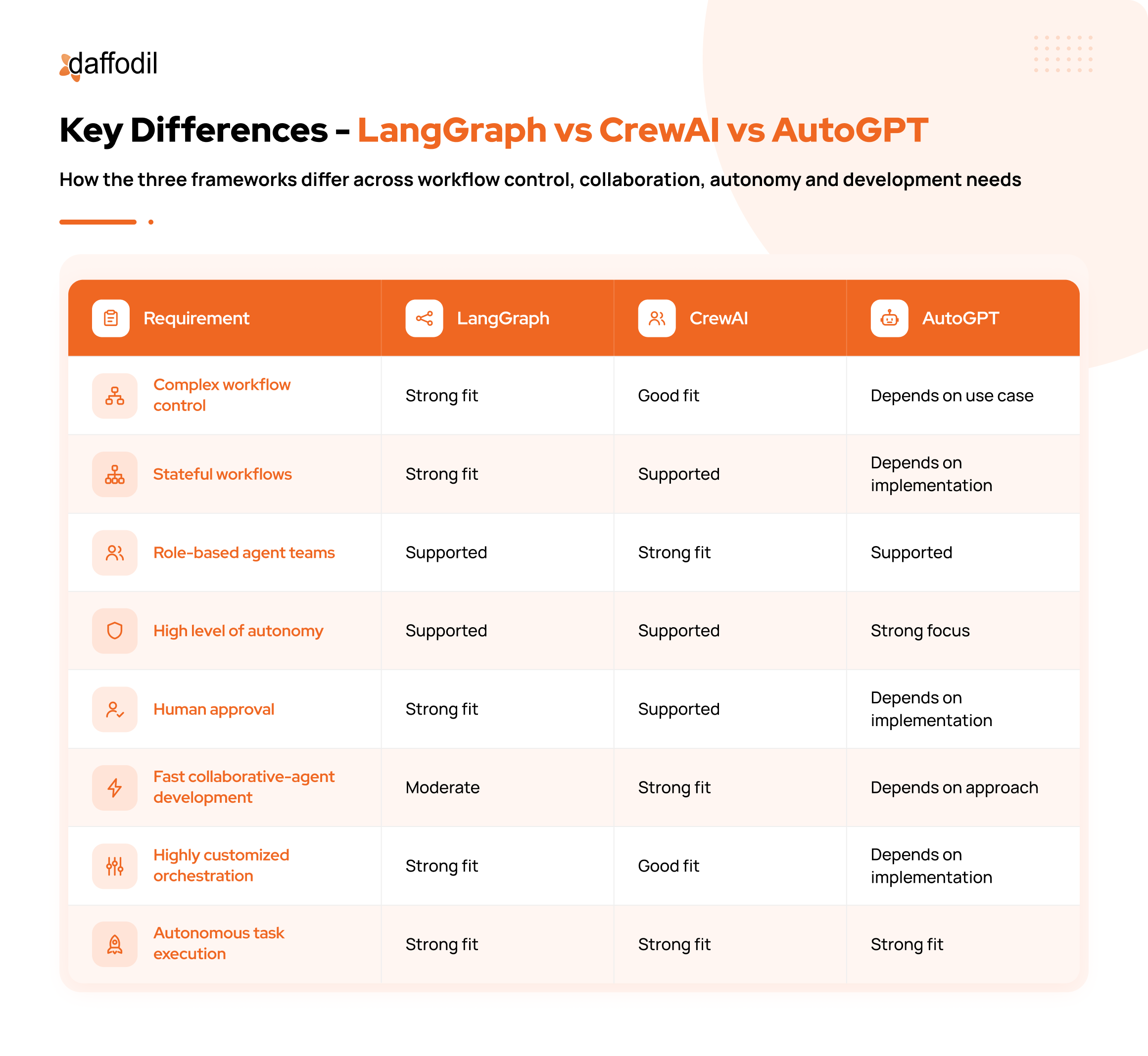
The comparison shows that the three frameworks have different strengths rather than one clear winner. LangGraph leans toward control and workflow customisation, CrewAI makes collaborative agent development more straightforward, while AutoGPT is better aligned with applications that require greater autonomy.
The choice ultimately comes down to how your application needs to work, how much control your team wants, and how complex the system is expected to become.
## **LangGraph: Control Over Complex Agent Workflows**
LangGraph is a good fit when you need a clear idea of what your agents are doing at each stage of a task. Rather than giving you a ready-made multi-agent setup, it gives you the building blocks to design the workflow yourself. You define the different steps, decide how they connect and choose where the AI should make a decision and where the application should follow a fixed rule. The[LangGraph documentation](https://docs.langchain.com/oss/python/langgraph/overview?utm_source=chatgpt.com) describes this approach around controllable, stateful agent workflows, with features for persistence, memory and human oversight.
That approach becomes useful when the workflow is more complicated than a simple "agent A sends something to agent B." One agent might collect information, another might review it and the system may need to decide what happens next based on the result. Some cases may require another round of analysis, while others can move directly to completion. With LangGraph, you can define those paths instead of leaving the entire process to the model.
**What you get with LangGraph**
The framework gives you control over several parts of the workflow that can become difficult to manage as an application grows:
- **Workflow control:** You decide which step runs next and what conditions determine the next path.
- **State management:** The system can maintain information as a task moves through multiple stages.
- **Persistence:** A workflow can save its progress and continue after an interruption instead of starting again from the beginning.
- **Human approval:** You can pause a workflow at a specific point and wait for a person to review or approve the next action.
- **Flexible orchestration:** You can combine predictable application logic with steps where an AI agent makes the decision.
The state and persistence capabilities are particularly useful for long-running tasks. An agent does not have to treat every interaction as a completely new request. Information from the current task can remain available as the workflow moves from one step to another, while longer-term information can be stored for situations where it may be needed later.
### **Where LangGraph make sense?**
Consider an AI system for processing insurance claims. One agent reviews the submitted documents, another checks the policy details and a third prepares a recommendation based on what the first two agents found.
The workflow does not necessarily end there. If the claim is below a certain value and all the required information is present, it could continue automatically. If the claim is unusually large or something in the documentation does not match, the system could stop and ask a human adjuster to review it. That kind of process is where LangGraph becomes useful. **You can make the approval point part of the workflow itself**, rather than building a separate human-review process around the AI system. The workflow pauses, the reviewer makes a decision and the system continues from that point.
This matters in applications where an AI agent is not simply producing an answer but is taking actions that have real consequences. A human may need to approve a financial transaction, review an insurance decision, check sensitive information, or intervene when the system reaches a situation it was not designed to handle automatically.
### **Where LangGraph Can Get Complex?**
The flexibility that makes LangGraph useful also means that your development team has more responsibility. You have to think through the workflow, state, transitions, failure cases and situations where a human should take over.
That can mean more work at the beginning compared with a framework that gives you a more opinionated way to create a team of agents. But for a production application, that extra effort can be worthwhile when you need to know **why a particular step happened, what information the system was using, and what should happen when something goes wrong**.
A useful way to think about LangGraph is that it gives you the **control layer** rather than trying to make all the orchestration decisions for you. That makes it particularly suitable for applications where the workflow itself is an important part of the product, especially when you need state, branching logic, persistence, or human approval.
For teams building these systems, the framework is only one part of the decision. Your agent design, tools, data flows, monitoring, and approval process will ultimately determine how well the application works in production. This is where a broader[AI development](https://www.daffodilsw.com/ai-development-services/) strategy becomes important: the framework should support the architecture you actually need, rather than forcing the architecture to fit the framework.
## **CrewAI: Building Teams of Specialized AI Agents**
The CrewAI framework is built around the idea that different agents can take on different responsibilities and work together toward a shared objective. You define an agent's role, goal, background, and available tools, then assign it one or more tasks. CrewAI brings these agents together as a **Crew** rather than making you define every interaction as an individual workflow step. Its[official documentation](https://docs.crewai.com/?utm_source=chatgpt.com) describes **Agents, Tasks, Crews, and Flows** as the main building blocks of the framework.
This approach can feel more natural when the problem itself already looks like a team of specialists working together. For example, a market research application might have:
- **Research Agent**: collects information about the market and relevant companies.
- **Competitor Agent**: focuses specifically on competitor products, pricing, and positioning.
- **Analysis Agent**: compares the information gathered by the other agents and identifies important findings.
- **Report Agent**: turns those findings into a structured report for the user.
You are not asking one agent to research, analyse and write everything in a single step. Each agent has a defined responsibility, and the Crew coordinates the work between them.
### **Where CrewAI works well**
CrewAI is particularly useful when the work can be divided into clear roles. Some common examples include:
- **Market research:** one agent gathers information while others analyse competitors, trends and customer segments.
- **Content workflows:** agents can handle research, outlining, drafting and review as separate responsibilities.
- **Customer operations:** different agents can handle document checks, customer queries and follow-up actions.
- **Business analysis:** agents can collect data, analyse it and prepare recommendations for a final decision.
The framework also supports **delegation**, so an agent can ask another agent to handle a task when it needs specialist help. This makes the interaction less rigid than simply running a fixed sequence of steps.
CrewAI also has **Flows**, which become useful when a Crew needs to sit inside a more structured application. A Flow can manage state, conditional logic, and events and can coordinate multiple Crews as part of a larger process. This gives you a way to start with straightforward agent collaboration and add more orchestration as the application grows.
### **Where CrewAI May Need More Structure**
The role-based approach is one of CrewAI's biggest strengths, but it can also become a limitation when the workflow needs very precise control.
If you need to define exactly **which agent runs next, what condition triggers that transition, where the workflow should pause, or what should happen when a particular step fails**, you may need to add more structure around the Crew. That is where Flows become important, but it can also mean that a project that started as a simple group of collaborating agents gradually becomes a more involved orchestration system.
So the key question with CrewAI is not simply whether you can build a multi-agent system with it but whether **your application naturally looks like a group of specialists working toward the same goal** or not.
If the answer is yes, CrewAI's role-based model can make the architecture easier for your development team to understand. You can give each agent a clear responsibility, keep the individual tasks focused and introduce Flows when the surrounding business process needs more control. That makes CrewAI a particularly interesting option for teams that want to get a collaborative multi-agent application running without having to design every interaction from the ground up.
## **AutoGPT: Autonomous Task Execution**
AutoGPT is probably the most familiar name among the three, largely because of the attention it received when autonomous AI agents first started becoming widely discussed. But the project has changed considerably since then. The current[AutoGPT platform](https://github.com/Significant-Gravitas/AutoGPT?utm_source=chatgpt.com) is built around creating, deploying and running AI agents, with a visual builder, integrations, agent management and options for running agents on a schedule or in response to events. The important difference is how much freedom you give the agent to decide what happens next.
In a structured setup, the path is usually decided before the task begins. AutoGPT gives the agent more room to figure out that path itself, deciding what it needs to look for, which actions are useful and what it should do next as the task develops. That can be useful when the exact path is difficult to predict in advance.
### **Where AutoGPT fits well**
Consider a company that wants to monitor its competitors every week. The agent could be given a broader goal such as tracking product updates, pricing changes and important announcements, then preparing a report for the team.
The work can also change from one run to the next. One week the agent may need to investigate a product launch, while the next it may spend more time looking into pricing changes or decide that there is nothing significant to report. An autonomous agent can instead decide which information it needs, use the available tools and work through the task based on what it finds.
This makes AutoGPT particularly interesting for tasks such as:
- **Research and monitoring**: tracking competitors, markets, products or other information that changes regularly.
- **Sales support**: researching prospects and preparing information before a sales conversation.
- **Recurring reporting**: collecting information from different sources and preparing regular updates.
- **Content research**: gathering information and preparing material around a defined topic.
- **Business operations**: carrying out repeatable tasks across connected tools and services.
The current platform also gives you a visual way to build agents rather than requiring everything to be written from scratch. You can connect different actions, add logic and define how information moves through the process using the[AutoGPT visual builder](https://agpt.co/).
### **Why Autonomous Agents Need Guardrails**
Giving an agent more freedom also means giving it more opportunities to make unnecessary decisions. A poorly bounded agent may continue making tool calls after it has already gathered enough information. It may follow an unhelpful path, spend more on model calls than expected, or attempt an action that should have required human approval. That is why autonomous systems need clear boundaries around what they can do.
For a production application, you should consider:
- **Permissions:** Which systems and data can the agent access?
- **Spending limits:** How many model and tool calls can it make?
- **Stopping conditions:** What tells the agent that the task is finished?
- **Approval points:** Which actions require a person to review them first?
- **Monitoring:** Can your team see what the agent has done and why?
These safeguards become particularly important when an agent moves beyond generating information and starts taking actions. Sending an email is different from drafting one. Updating a database is different from suggesting an update. Making a payment or changing a customer record requires an even higher level of control.
### **When autonomy is more useful than a fixed workflow**
This is where AutoGPT has a different proposition from LangGraph and CrewAI.
*"LangGraph gives you control over the workflow. CrewAI gives you a natural structure for teams of specialized agents. AutoGPT puts more emphasis on giving an agent a goal and allowing it to work out the path."*
That difference matters when you are deciding which framework to use. If you already know exactly how a process should work, giving an agent complete freedom may create unnecessary uncertainty. But if the task involves changing information, multiple possible paths and decisions that cannot easily be mapped in advance, a more autonomous approach can be useful.
The real question is therefore not whether AutoGPT is more autonomous than the other frameworks. It is whether your use case benefits from that autonomy enough to justify the additional control and monitoring it requires.
## **LangGraph vs CrewAI vs AutoGPT: Key Differences**
Before comparing the three frameworks in detail, it helps to look at the requirements that typically shape a production multi-agent system. **Workflow control and statefulness** matter when applications need predictable, multi-step processes, while **role-based agent** **teams and fast collaborative development** become more important when agents need to work together around defined responsibilities. **Autonomy** is another key consideration, particularly for applications where agents are expected to execute tasks with less human intervention. At the same time, **human approval and customized orchestration** can be critical when teams need greater control over how agents make decisions and move through a workflow.
### **The Framework Is Only One Part of the Architecture**
Choosing the framework is important but it does not solve everything. A production multi-agent system still needs a clear approach to memory, permissions, failures, human approvals and cost monitoring.
For example, agents may need different levels of access to business data, a tool may become unavailable, or a workflow may keep running longer than expected. These situations need to be considered while designing the system, rather than after the application is already in production.
The same applies to cost. A workflow that looks like one task to the user may involve several model calls and tool interactions behind the scenes. Without proper monitoring, unnecessary calls, repeated retries, or excessive context can quickly increase both latency and cost. So, the framework should be treated as **one part of the architecture, not the architecture itself**. The way agents communicate, use tools, manage memory, handle failures, and operate within business rules will ultimately determine how reliable the system is.
For teams moving from a prototype to a production-ready system,[Generative AI development](https://www.daffodilsw.com/generative-ai-services-and-solutions?utm_source=chatgpt.com) and[AI strategy consulting](https://www.daffodilsw.com/ai-consulting-services?utm_source=chatgpt.com) can help address these architectural decisions alongside the framework choice.
## **Which Multi-Agent Framework Should You Choose?**
The comparison becomes much easier once you stop looking for a framework that is simply “the best” and instead look at where each one fits.
- **Choose LangGraph** when the application needs a workflow that developers can control closely. It is particularly useful for systems with branching processes, persistent state, checkpoints, or human approval.
- **Choose CrewAI** when collaboration between specialized agents is central to the application. Its role-based approach can make sense when the workflow naturally breaks into different responsibilities and the team wants a straightforward way to organize those agents.
- **Choose AutoGPT** when the application needs an agent to work toward a broader objective with less of the process defined in advance. This can be useful for open-ended tasks where the path to the final result may change as the agent works.
There is also a practical consideration that is easy to overlook: your development team's comfort with the framework. A highly flexible framework can give experienced engineers more control, while a more opinionated approach may help a team get a working system together faster. So the choice is less about comparing feature lists and more about matching the framework to the way the application needs to operate.
## **Conclusion**
The bigger lesson from comparing LangGraph, CrewAI and AutoGPT is that multi-agent development is moving beyond simply connecting several AI models and asking them to work together. The difficult part is designing a system that knows what each agent should be responsible for, what information it should have access to, and how much freedom it should be given.
A framework can make those decisions easier to implement, but it cannot make them for you. The architecture still needs to account for data, tools, memory, permissions, model selection, monitoring, and the points where human involvement is necessary. That is also why a framework that works well for one project may be a poor choice for another. A research assistant, an automated customer-support workflow and an enterprise process involving sensitive data can have very different requirements even if all three are described as “multi-agent applications.”
For businesses planning to take multi-agent AI beyond experimentation,[Daffodil's AI agent development services](https://www.daffodilsw.com/ai-agent-development-company/) can support the broader engineering work needed to turn an AI concept into a production-ready application.
**The framework is a tool. The real advantage comes from knowing what you want the system to do before you decide which tool to build it with.**
Topics: [Artificial Intelligence](https://insights.daffodilsw.com/blog/topic/artificial-intelligence) [Agentic AI](https://insights.daffodilsw.com/blog/topic/agentic-ai)

#### Written by [Chhalak Pathak](https://insights.daffodilsw.com/blog/author/chhalak-pathak)
Chhalak Pathak has experience in content marketing, SEO, AI-powered marketing and B2B communications, with a passion for turning complex ideas into content that people can actually understand and engage with. Her work spans blogs, case studies, thought leadership, social media and marketing campaigns across technology, fintech and emerging digital trends.
[\[fa icon="linkedin-square"\]](https://www.linkedin.com/in/chhalakpathakmba)
Previous Post
[](https://insights.daffodilsw.com/blog/building-token-efficient-ai-architecture-for-applications)
[Building Token-Efficient Architecture for AI Applications](https://insights.daffodilsw.com/blog/building-token-efficient-ai-architecture-for-applications)
Next Post
[](https://insights.daffodilsw.com/blog/finops-for-ai-managing-token-spend-like-cloud-infrastructure)
[FinOps for AI: Managing Token Spend Like Cloud Infrastructure](https://insights.daffodilsw.com/blog/finops-for-ai-managing-token-spend-like-cloud-infrastructure)
### Stay Ahead of the Curve with Our Weekly Tech Insights
- Recent
- Popular
- Categories
### Lists by Topic
- [Artificial Intelligence (203)](https://insights.daffodilsw.com/blog/topic/artificial-intelligence)
- [Software Development (182)](https://insights.daffodilsw.com/blog/topic/software-development)
- [Mobile App Development (169)](https://insights.daffodilsw.com/blog/topic/mobile-app-development)
- [Healthcare (141)](https://insights.daffodilsw.com/blog/topic/healthcare)
- [DevOps (81)](https://insights.daffodilsw.com/blog/topic/devops)
- [Digital Commerce (64)](https://insights.daffodilsw.com/blog/topic/digital-commerce)
- [Web Development (59)](https://insights.daffodilsw.com/blog/topic/web-development)
- [CloudOps (55)](https://insights.daffodilsw.com/blog/topic/cloudops)
- [Digital Transformation (37)](https://insights.daffodilsw.com/blog/topic/digital-transformation)
- [Fintech (37)](https://insights.daffodilsw.com/blog/topic/fintech)
- [Software Architecture (31)](https://insights.daffodilsw.com/blog/topic/software-architecture)
- [UI/UX (31)](https://insights.daffodilsw.com/blog/topic/ui-ux)
- [On - Demand Apps (26)](https://insights.daffodilsw.com/blog/topic/on-demand-apps)
- [Internet of Things (IoT) (25)](https://insights.daffodilsw.com/blog/topic/internet-of-things-iot)
- [Open Source (25)](https://insights.daffodilsw.com/blog/topic/open-source)
- [Outsourcing (24)](https://insights.daffodilsw.com/blog/topic/outsourcing)
- [Blockchain (22)](https://insights.daffodilsw.com/blog/topic/blockchain)
- [Technology (22)](https://insights.daffodilsw.com/blog/topic/technology)
- [Newsroom (21)](https://insights.daffodilsw.com/blog/topic/newsroom)
- [Salesforce (21)](https://insights.daffodilsw.com/blog/topic/salesforce)
- [Software Testing (21)](https://insights.daffodilsw.com/blog/topic/software-testing)
- [StartUps (17)](https://insights.daffodilsw.com/blog/topic/startups)
- [Customer Experience (15)](https://insights.daffodilsw.com/blog/topic/customer-experience)
- [Voice User Interface (14)](https://insights.daffodilsw.com/blog/topic/voice-user-interface)
- [Robotic Process Automation (13)](https://insights.daffodilsw.com/blog/topic/robotic-process-automation)
- [Javascript (11)](https://insights.daffodilsw.com/blog/topic/javascript)
- [OTT Apps (11)](https://insights.daffodilsw.com/blog/topic/ott-apps)
- [Big Data (10)](https://insights.daffodilsw.com/blog/topic/big-data)
- [Business Intelligence (10)](https://insights.daffodilsw.com/blog/topic/business-intelligence)
- [Data Enrichment (10)](https://insights.daffodilsw.com/blog/topic/data-enrichment)
- [Infographic (10)](https://insights.daffodilsw.com/blog/topic/infographic)
- [Education (9)](https://insights.daffodilsw.com/blog/topic/education)
- [Microsoft (6)](https://insights.daffodilsw.com/blog/topic/microsoft)
- [Real Estate (5)](https://insights.daffodilsw.com/blog/topic/real-estate)
- [Agentic AI (4)](https://insights.daffodilsw.com/blog/topic/agentic-ai)
- [Banking (4)](https://insights.daffodilsw.com/blog/topic/banking)
- [Game Development (4)](https://insights.daffodilsw.com/blog/topic/game-development)
- [Enterprise Mobility (3)](https://insights.daffodilsw.com/blog/topic/enterprise-mobility)
- [Hospitality (3)](https://insights.daffodilsw.com/blog/topic/hospitality)
- [AI Architecture (2)](https://insights.daffodilsw.com/blog/topic/ai-architecture)
- [Coding (2)](https://insights.daffodilsw.com/blog/topic/coding)
- [Generative AI (2)](https://insights.daffodilsw.com/blog/topic/generative-ai)
- [eLearning (2)](https://insights.daffodilsw.com/blog/topic/elearning)
- [Context Engineering (1)](https://insights.daffodilsw.com/blog/topic/context-engineering)
- [Public Sector (1)](https://insights.daffodilsw.com/blog/topic/public-sector)
- [Software Engineering (1)](https://insights.daffodilsw.com/blog/topic/software-engineering)
- [cloud migration (1)](https://insights.daffodilsw.com/blog/topic/cloud-migration)
- [database migration (1)](https://insights.daffodilsw.com/blog/topic/database-migration)
see all
### Posts by Topic
- [Artificial Intelligence (203)](https://insights.daffodilsw.com/blog/topic/artificial-intelligence)
- [Software Development (182)](https://insights.daffodilsw.com/blog/topic/software-development)
- [Mobile App Development (169)](https://insights.daffodilsw.com/blog/topic/mobile-app-development)
- [Healthcare (141)](https://insights.daffodilsw.com/blog/topic/healthcare)
- [DevOps (81)](https://insights.daffodilsw.com/blog/topic/devops)
- [Digital Commerce (64)](https://insights.daffodilsw.com/blog/topic/digital-commerce)
- [Web Development (59)](https://insights.daffodilsw.com/blog/topic/web-development)
- [CloudOps (55)](https://insights.daffodilsw.com/blog/topic/cloudops)
- [Digital Transformation (37)](https://insights.daffodilsw.com/blog/topic/digital-transformation)
- [Fintech (37)](https://insights.daffodilsw.com/blog/topic/fintech)
- [Software Architecture (31)](https://insights.daffodilsw.com/blog/topic/software-architecture)
- [UI/UX (31)](https://insights.daffodilsw.com/blog/topic/ui-ux)
- [On - Demand Apps (26)](https://insights.daffodilsw.com/blog/topic/on-demand-apps)
- [Internet of Things (IoT) (25)](https://insights.daffodilsw.com/blog/topic/internet-of-things-iot)
- [Open Source (25)](https://insights.daffodilsw.com/blog/topic/open-source)
- [Outsourcing (24)](https://insights.daffodilsw.com/blog/topic/outsourcing)
- [Blockchain (22)](https://insights.daffodilsw.com/blog/topic/blockchain)
- [Technology (22)](https://insights.daffodilsw.com/blog/topic/technology)
- [Newsroom (21)](https://insights.daffodilsw.com/blog/topic/newsroom)
- [Salesforce (21)](https://insights.daffodilsw.com/blog/topic/salesforce)
- [Software Testing (21)](https://insights.daffodilsw.com/blog/topic/software-testing)
- [StartUps (17)](https://insights.daffodilsw.com/blog/topic/startups)
- [Customer Experience (15)](https://insights.daffodilsw.com/blog/topic/customer-experience)
- [Voice User Interface (14)](https://insights.daffodilsw.com/blog/topic/voice-user-interface)
- [Robotic Process Automation (13)](https://insights.daffodilsw.com/blog/topic/robotic-process-automation)
- [Javascript (11)](https://insights.daffodilsw.com/blog/topic/javascript)
- [OTT Apps (11)](https://insights.daffodilsw.com/blog/topic/ott-apps)
- [Big Data (10)](https://insights.daffodilsw.com/blog/topic/big-data)
- [Business Intelligence (10)](https://insights.daffodilsw.com/blog/topic/business-intelligence)
- [Data Enrichment (10)](https://insights.daffodilsw.com/blog/topic/data-enrichment)
- [Infographic (10)](https://insights.daffodilsw.com/blog/topic/infographic)
- [Education (9)](https://insights.daffodilsw.com/blog/topic/education)
- [Microsoft (6)](https://insights.daffodilsw.com/blog/topic/microsoft)
- [Real Estate (5)](https://insights.daffodilsw.com/blog/topic/real-estate)
- [Agentic AI (4)](https://insights.daffodilsw.com/blog/topic/agentic-ai)
- [Banking (4)](https://insights.daffodilsw.com/blog/topic/banking)
- [Game Development (4)](https://insights.daffodilsw.com/blog/topic/game-development)
- [Enterprise Mobility (3)](https://insights.daffodilsw.com/blog/topic/enterprise-mobility)
- [Hospitality (3)](https://insights.daffodilsw.com/blog/topic/hospitality)
- [AI Architecture (2)](https://insights.daffodilsw.com/blog/topic/ai-architecture)
- [Coding (2)](https://insights.daffodilsw.com/blog/topic/coding)
- [Generative AI (2)](https://insights.daffodilsw.com/blog/topic/generative-ai)
- [eLearning (2)](https://insights.daffodilsw.com/blog/topic/elearning)
- [Context Engineering (1)](https://insights.daffodilsw.com/blog/topic/context-engineering)
- [Public Sector (1)](https://insights.daffodilsw.com/blog/topic/public-sector)
- [Software Engineering (1)](https://insights.daffodilsw.com/blog/topic/software-engineering)
- [cloud migration (1)](https://insights.daffodilsw.com/blog/topic/cloud-migration)
- [database migration (1)](https://insights.daffodilsw.com/blog/topic/database-migration)
see all topics
### Elevate Your Software Project, Let's Talk Now
### Delaware, USA
3500, South Dupont Highway Dover, DE 19901 USA
Contact +1 518 676 2958
### London, UK
124 City Road, EC1V 2NX, London, UK
Contact +1 518 676 2958
### Dubai, UAE
407- 412, Clover Bay Tower, Business Bay, Dubai, UAE
Contact +1 518 676 2958
### Gurugram, India
9th Floor, Tower B1, DLF SEZ Silokhera, Sec 30, Gurgaon 122001
Contact +91 124 681 7000
---
Discover Daffodil
- [About Us](https://www.daffodilsw.com/about)
- [Leadership](https://www.daffodilsw.com/leadership)
- [Partners](https://www.daffodilsw.com/partners)
- [Career & culture](https://www.daffodilsw.com/career)
- [Corporate social responsibility](https://www.daffodilsw.com/corporate-social-responsibility)
- [Daffodil Software Reviews](https://www.daffodilsw.com/daffodil-software-reviews)
- [Privacy Policy](https://www.daffodilsw.com/privacy-policy)
Industries
- [Healthcare](https://www.daffodilsw.com/healthcare-software-development-services)
- [Software technology](https://www.daffodilsw.com/software-development-services)
- [Fintech](https://www.daffodilsw.com/fintech-software-development)
- [Banking](https://www.daffodilsw.com/banking-it-services)
- [Real Estate](https://www.daffodilsw.com/real-estate-software-development-solutions)
- [Travel & Logistics](https://www.daffodilsw.com/travel-application-development-services)
- [Public Sector](https://www.daffodilsw.com/it-solutions-for-public-sector)
- [Media & Entertainment](https://www.daffodilsw.com/media-and-entertainment-software-solutions)
- [Food & Beverages](https://www.daffodilsw.com/industries/food-and-beverages-software-solutions)
Services
- [Software Engineering Services](https://www.daffodilsw.com/software-engineering-services)
- [Product Discovery Services](https://www.daffodilsw.com/product-discovery-services)
- [Software Development Services](https://www.daffodilsw.com/software-development-services)
- [Software Testing Services](https://www.daffodilsw.com/software-testing-services)
- [Managed Cloud Services](https://www.daffodilsw.com/managed-cloud-services)
- [Software Support & Maintenance](https://www.daffodilsw.com/software-maintenance-and-support-services)
- [Smart Teams](https://www.daffodilsw.com/smart-teams)
- [Hire Software Developers](https://www.daffodilsw.com/hire-dedicated-developers)
- [Technology Consulting](https://www.daffodilsw.com/software-consulting-services)
- [Robotic Process Automation](https://www.daffodilsw.com/software-development-services/enterprise-it-solutions/robotic-process-automation)
- [Legacy Modernisation](https://www.daffodilsw.com/software-reengineering-services)
- [Enterprise Mobility Services](https://www.daffodilsw.com/enterprise-mobility-services)
Domain Expertise
- [Mobile App Development](https://www.daffodilsw.com/mobile-app-development-company)
- [UI/UX Design Services](https://www.daffodilsw.com/ui-ux-design-services)
- [DevOps](https://www.daffodilsw.com/devops-services)
- [Cloud Services](https://www.daffodilsw.com/cloud-application-development-services)
- [Artificial Intelligence](https://www.daffodilsw.com/ai-development-services)
- [Digital Commerce Solutions](https://www.daffodilsw.com/ecommerce-development-services)
- [IoT Solutions](https://www.daffodilsw.com/iot-application-development)
- [eLearning Solutions](https://www.daffodilsw.com/custom-elearning-software-development)
- [Business Intelligence](https://www.daffodilsw.com/business-intelligence-services)
- [Performance Marketing](https://www.daffodilsw.com/digital-marketing-services)
- [Data Enrichment](https://www.daffodilsw.com/data-enrichment-services)
- [OTT Platforms](https://www.daffodilsw.com/ott-application-development)
- [Managed IT Services](https://www.daffodilsw.com/managed-it-services)
- [Application Security](https://www.daffodilsw.com/application-security-services)
Follow Us On
- [](https://www.facebook.com/daffodilsw)
- [](https://www.linkedin.com/company/daffodil-software-ltd-)
- 
- [](https://twitter.com/daffodilsw)
Get In Touch
E-mail us at: [info@daffodilsw.com](mailto:info@daffodilsw.com)
[](https://www.daffodilsw.com/)

A CMMI level 3 Company
© Daffodil Unthinkable Software Corp. 2026 - All Rights Reserved
```json
{
"@context" : "https://schema.org",
"@type" : "BlogPosting",
"author" : {
"@type" : "Person",
"name" : "Chhalak Pathak",
"url" : "https://insights.daffodilsw.com/blog/author/chhalak-pathak"
},
"dateModified" : "2026-09-14T05:39:15.429Z",
"datePublished" : "2026-08-20T06:18:16.000Z",
"headline" : "LangGraph vs CrewAI vs AutoGPT: Best Multi-Agent Framework in 2026",
"image" : [ "https://insights.daffodilsw.com/hubfs/Banner%20image_LangGraph%20vs%20CrewAI%20vs%20AutoGPT.webp" ],
"mainEntityOfPage" : {
"@id" : "https://insights.daffodilsw.com/blog/langgraph-vs-crewai-vs-autogpt-best-multi-agent-framework",
"@type" : "WebPage"
},
"publisher" : {
"@type" : "Organization",
"logo" : {
"@type" : "ImageObject",
"url" : "https://insights.daffodilsw.com/hubfs/daffodil-logo-ppc.png"
},
"name" : "Daffodil Software Private Limited"
}
}
```
```json
{
"@context" : "http://schema.org",
"@type" : "Organization",
"address" : {
"@type" : "PostalAddress",
"addressCountry" : "",
"addressLocality" : "Dover",
"addressRegion" : "DE",
"postalCode" : "",
"streetAddress" : "3500, South Dupont Highway "
},
"alternateName" : "Daffodil Software",
"areaServed" : {
"@type" : "GeoCircle",
"geoMidpoint" : {
"@type" : "GeoCoordinates",
"latitude" : "+42.9127243",
"longitude" : "-85.75507619999996"
},
"geoRadius" : "150 km"
},
"description" : "Daffodil Software is a software product engineering and team augmentation partner to 80+ organizations across the globe. Leverage our expertise in cutting edge technologies and our developmental excellence to build robust and scalable software products in optimum time and costs. Contact Now!",
"email" : "info@daffodilsw.com",
"image" : "www.daffodilsw.com/wp-content/uploads/2018/05/logo@2x.png",
"logo" : "https://appdevelopment.daffodilsw.com/hubfs/new-daffodilsw/logo@2x.png",
"mainEntityOfPage" : {
"@id" : "https://insights.daffodilsw.com/blog/langgraph-vs-crewai-vs-autogpt-best-multi-agent-framework",
"@type" : "WebPage",
"description" : "Compare LangGraph vs CrewAI vs AutoGPT to understand their key differences, strengths, use cases, and trade-offs, and find the right multi-agent framework"
},
"name" : "Daffodil Unthinkable Software Corp",
"sameAs" : [ "https://www.facebook.com/daffodilsw", "https://twitter.com/daffodilsw", "https://www.linkedin.com/company/daffodil-software-ltd-/", "https://www.youtube.com/channel/UC_FIqVM3B0RJLY1HtpAdRPw/videos", "https://plus.google.com/+DaffodilSoftwareLtdGurgaon" ],
"telephone" : "",
"url" : "http://www.daffodilsw.com"
}
```
```json
{
"@context" : "http://schema.org",
"@type" : "BlogPosting",
"author" : {
"@type" : "Person",
"name" : "Chhalak Pathak"
},
"dateModified" : "September 14, 2026, 5:39:15 AM",
"datePublished" : "2026-08-20 06:18:16",
"description" : "Compare LangGraph vs CrewAI vs AutoGPT to understand their key differences, strengths, use cases, and trade-offs, and find the right multi-agent framework",
"headline" : "LangGraph vs CrewAI vs AutoGPT: Best Multi-Agent Framework in 2026",
"image" : {
"@type" : "ImageObject",
"url" : "https://3024849.fs1.hubspotusercontent-na2.net/hubfs/3024849/Banner%20image_LangGraph%20vs%20CrewAI%20vs%20AutoGPT.webp"
},
"mainEntityOfPage" : {
"@id" : "https://insights.daffodilsw.com/blog/langgraph-vs-crewai-vs-autogpt-best-multi-agent-framework",
"@type" : "WebPage"
},
"publisher" : {
"@type" : "Organization",
"logo" : {
"@type" : "ImageObject",
"url" : "https://appdevelopment.daffodilsw.com/hubfs/new-daffodilsw/logo@2x.png"
},
"name" : "Daffodil Unthinkable Software Corp"
}
}
```